How to Make Marriage Work

ben-rosett-10609.jpg

In three months, my husband and I will celebrate 20 years of marriage. We dated for 2 1/2 years before we tied the knot and I believe that is a factor for success: Don’t jump into a lifelong commitment!

But another key to making it work is translating what your spouse says. You see, we don’t always say what we actually mean.  There are more positive underlying meanings that we’re missing out on! I’ll give you an example:

My husband does not like going to the doctor. He does not get checkups, despite the fact that I – his wife – am a cancer survivor and that he has some serious cancer issues on his side of the family. Naturally, I look out for him.

Me: Honey, would you mind if I make a colonoscopy appointment for you, now that you’re 50? (Translation: I care about you and want you to be around for awhile).

Him: I guess there’s no stopping you. (Translation: Oh thank you so much! I really appreciate that you love me so much to do that).


Death as a Teacher

o0ta3hn-thc-jakub-kriz.jpgFor something that affects each of us without fail, the subject of death remains taboo in our culture. Why?

2016 was rife with “surprise” celebrity deaths: Rickman, Bowie, Prince, Fisher and so many more. It’s sad to lose people we admire and love.

Yet, death can be the best teacher. It reminds us that life is, in the end, pretty short. It can clarify values pretty quickly. Six and half years ago, I was told by my doctor that I had cancer. I was fortunate – it was early stage I breast cancer – and my prognosis was very good. But I was 41 and not expecting that diagnosis at all. My life got crystal clear: Family and friends were priority. I realized that my job – teaching – was something I truly valued and I was grateful for it.

As I walked out of the hospital to go home to recover from my radical mastectomy, the air was crisp, the sun shone brightly and I noticed practically every blade of grass of the hospital lawn. I felt so alive!

Realizing that we don’t have much time gives us urgency. Don’t waste a day complaining. Don’t be negative. Live in the light of positivity and gratitude. Work towards your dreams. You might not have much time.


My Family Is Angry with Me Because…

I bought this instead of Jiffy.


nutty


When you know better, you do better, even if people will be poopie about it.

Why did I make the change? Because I promised the Power That Be that I would eat better if I could survive cancer. Because natural is better than artificial. Because I want my family to be healthy.

Ingredients in Jiffy Peanut Butter:

MADE FROM ROASTED PEANUTSAND SUGAR, CONTAINS 2% OR LESS OF: MOLASSES, FULLY HYDROGENATED VEGETABLE OILS (RAPESEED AND SOYBEAN), MONO AND DIGLYCERIDES, SALT.

Ingredients in Laura Scudder’s All Natural Peanut Butter:

SALT AND PEANUTS.


Notice More

I just saw an old interview with Michael Landon. I was a HUGE fan of the Little House on the Prairie shows and I also liked Bonanza. When Landon died of cancer, the world was shocked. He announced his pancreatic cancer diagnosis and was dead less than three months later.

Something he said in his video keeps coming back to me. He said that knowing the end was near – with certainty – he “noticed” things more…about his loved ones and his life. I remember when I was diagnosed with breast cancer six years ago – although not any where as serious as Landon’s diagnosis – I was in shock and everything important in my life MAGNIFIED and irrelevant things fell to the wayside. In a way, I never felt more alive.

Since then, I’ve noticed things a little less again. I’ve gotten comfortable and I am aware of this digression.

My hope is that people will have this “awakening” long before a diagnosis. What is really important to you? WHO is important? Notice things more. Slow down.

Live like you’re going to die.


The Six Year Audit – Post Cancer

soma-minimizer-bra-fb-75795097

I’ve recently celebrated my 6th year

“cancer-free” anniversary.

For background, you can read my posts during my treatment and the recovery. It’s been an amazing journey, for sure. I’m humbled and a bit sheepish to even say I am a cancer-survivor for I did not have to endure chemo or radiation treatments. However, I do believe I can help others who have been given a cancer diagnosis, because I understand the shock and all the stages that accompany it. I also had a rough reconstruction process which included infections, a defective implant and 5 surgeries.

Anniversaries are a great time for reflection. Looking back, am I stronger now? Less materialistic? Grateful? Kinder? I believe I am. I know I’ve made a concerted effort to be those things. I definitely know the importance of living with presence and that is why I’ve been writing about that so much in my blog. Today is the only day we know we have. Yesterday is over. Tomorrow has yet to arrive. So cliche, but true!

I am blessed to have a healthy, wonderful family and a career I love. I have an opportunity – every day – to think, be creative, and write.

For all my women friends out there (those I have met and those I have yet to meet) – for you who are handling a personal struggle challenge: you can do it. You can and you will overcome. Take it one day at a time.


Calla Devlin,

Readers, I’m thrilled to share my interview with Calla Devlin. We were in a San Francisco writing group together over 12 years ago. She’s worked hard at her craft, balancing marriage, children, and full-time jobs. She is a testament to staying focused and true to one’s art and she shares her lessons here.

Kismet:  First of all, I want to say, I am really looking forward to reading your novel. The book description (due out in Fall day+of+the+dead+lady2016) reads: Tell Me Something Real tells the story of three beautiful blond sisters who travel with their mother into Mexico so she can receive alternative cancer treatments for her leukemia, all the while remaining completely unaware that an illness far more insidious than cancer poisons their home, and that their world will shatter under the weight of an incomprehensible betrayal. I remember when we were in the Kicking Muses writing group together in San Francisco (over 12 years ago!) and here you are, on the brink of getting a novel published!

calladevlinCalla Devlin:  That writing group was so valuable to me. I did share several chapters of this novel with the group, and I published a few chapters as stand-alone stories in anthologies and literary journals. Writing this book was a long process. It started out as a collection of linked stories and then a book that explored the characters as adults. Ultimately, I needed to narrow the focus of the novel to a single protagonist and the events that unfolded one summer.

Kismet: Did you ever doubt yourself or get tired of the storyline? I know many writers, including myself, doubt our stories time to time. How do you get over that?

Calla Devlin: I wrote several complete drafts of this novel. Originally, it started out as a collection of linked stories with chapters told from various points-of-view–six in all. This novel changed so much with every draft and i discovered myself and my voice in the process. But it was a very labor intensive process, and when you’re balancing being a mom and working full time and writing drafts of a novel, doubting yourself is inevitable. While it was a struggle at times, I am very fortunate to have a champion of a literary agent, who encouraged me every step of the way. Also, being in writing groups also kept me motivated and committed.

Writing is a solitary and fearless act. We sit alone before the computer and dare ourselves to be original and honest with our stories. Hesitation and doubt are a part of the process, but I truly believe that each and every one of us has a story to tell, whether written or spoken. And when we are able to share our stories, it is such a gift.

Kismet: You have two beautiful daughters of your own. Are you often inspired by mother/daughter relationships?

Calla Devlin: The mother-daughter relationship is so defining and complex, and I’m inspired by the interconnectedness of that relationship. I began Tell Me Something Real before I had children, and it was just a short story. While writing it, I had had my first daughter, then I lost my mother-in-law to cancer. She was very important to me and very much a mother figure. Then I had my second daughter. Becoming a mother and grief shaped the way I approached the book, and my sympathies for the various characters evolved over time. Because I write YA, I approach the material from the daughter’s point-of-view, and the myriad ways in which daughters need their mother’s support and approval—and what happens when that is somehow compromised. Also, the novel is as much about the sister relationship as the mother-daughter relationship.

Kismet: What do you hope your readers will feel or how will they be changed after reading your work?

Calla Devlin: Tell Me Something Real  is very much about resilience and a character who learns to trust herself and claim her voice. I, of course, want readers to feel connected to my characters, but I also hope readers are inspired to share their own stories.

Kismet:  Tell us what your writing process is. Do you have a strict schedule and process (where, when, how do you write)?

Calla Devlin: I’ve always balanced writing with work, and also with my family. I try to carve out writing time when I can. I don’t write every day, but I’m engaged with my writing every day. I read a great deal, which I think is an essential part of my process. There are weeks when I’ll write in every spare minute, and others when I write for just a couple of days. I cherish opportunities to take writing retreats.

Kismet: You’ve been published many times in many distinguished journals. Do you have advice for writers who write for the love of it, but also hope to get published?

Calla Devlin: If you love writing, write! I feel such joy when I am immersed in a novel and connected to my characters. I encourage everyone who loves writing to do just that—write for the joy of it. There are so many excellent literary journals in print and online. I read as many as I can and I think it’s important to submit to journals that share a similar editorial vision and voice. It is about finding a home for your work, which means that the journal is kindred. If you connect with a journal, it’s great to tell the editor why you’re submitting there and how you see your work being consistent with their publication. It requires reading and research, but the process is a wonderful one.

Calla Devlin’s website: http://www.calladevlin.com/

Calla’s debut novel is coming in the Fall of 2016 from Atheneum Books, a division of Simon & Schuster.

Maggie

Self-pity. You can be there in a matter of seconds. Grieving is feeling sorry for yourself, because your dog is no longer around to show you unfiltered, undiluted affection. You still expect her to come running to you when you return home from work…shopping….a night out at a restaurant.  You miss her quiet presence next to you while you type on your computer or read in bed.

Your dog is fine, she is no longer in pain. The cancerous tumor growing under her tongue and in her gums, pushing her tongue out the right side of her mouth can no longer hurt her. But you, you are left with loneliness and guilt. Why didn’t you stay home with her more? You should have walked her more often. You never took her to the dog park. Remember, you didn’t want her to catch any diseases, that’s why. Maggie was always the Beta dog. Cats were Alpha dogs compared to her. She quickly acquiesced to others. She hung her head low, shoulders cowered. She never harmed a thing. She could have been attacked at the dog park. You meant well.

When the kids were 3 months and 19 months old you took them and the dog for a walk to the post office on Mission Street. It was a daring undertaking with the infant in the Baby Bjorn, the toddler in the stroller and the frisky pup on a busy street, but you were going stir crazy with the diapers, the fog, and the boredom. You tied the puppy to a street sign post with a cement base. Just a few minutes in line and someone yelled, “There’s a dog running down the street with a post attached to her leash!” You looked outside and your dog was gone. You rushed home with two girls, not three. You cringe, expecting to hear screeching tires, screams. But they never come. You fight back the tears. You can’t lose her. When you get home, she is there, she took a different route, but somehow found your house. You are relieved and furious.

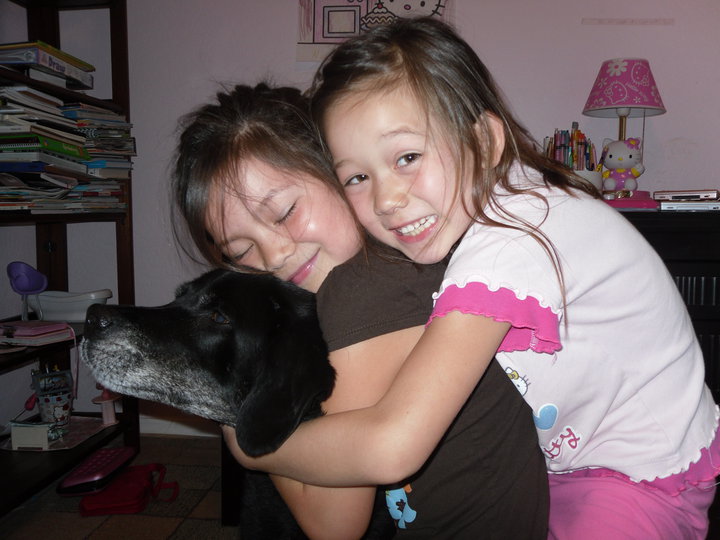
You miss her so much. The white snout, those sad eyes, even the stench of her infection. You miss those silky ears, the low growl of contentment she gave when you rubbed them. She jumped a foot off the ground when you came home. When you were recovering from your radical mastectomy, she napped next to you, choosing you over the rest of the family. Somehow, she knew you needed to rest. And while you worried about recurrent cancer, hers grew silently.

She loved bulgoki. Tennis balls. Hikes in the desert. She hated water. She would fetch when the mood fit. She was infinitely patient with children and other dogs. She was awesome.

You knew the end was near when she couldn’t eat. She loved to eat. And then she couldn’t drink water. Blood oozed from her infection, the antibiotics didn’t seem to have any effect. She drooled a thick, bloody mucous and you wiped her gently, frequently, sadly. How do you know when the time has come?

She was on the table, injected with a sedative. She looked so peaceful, striking her usual pose with one paw over the other, her eyes getting sleepy. You were grateful to see her comfortable. You told her you love her over and over again. Her eyes never left you. You bawled. The lethal injection worked quickly. You heard your husband say, “It’s OK, Maggie, you can go.”

And she’s gone.