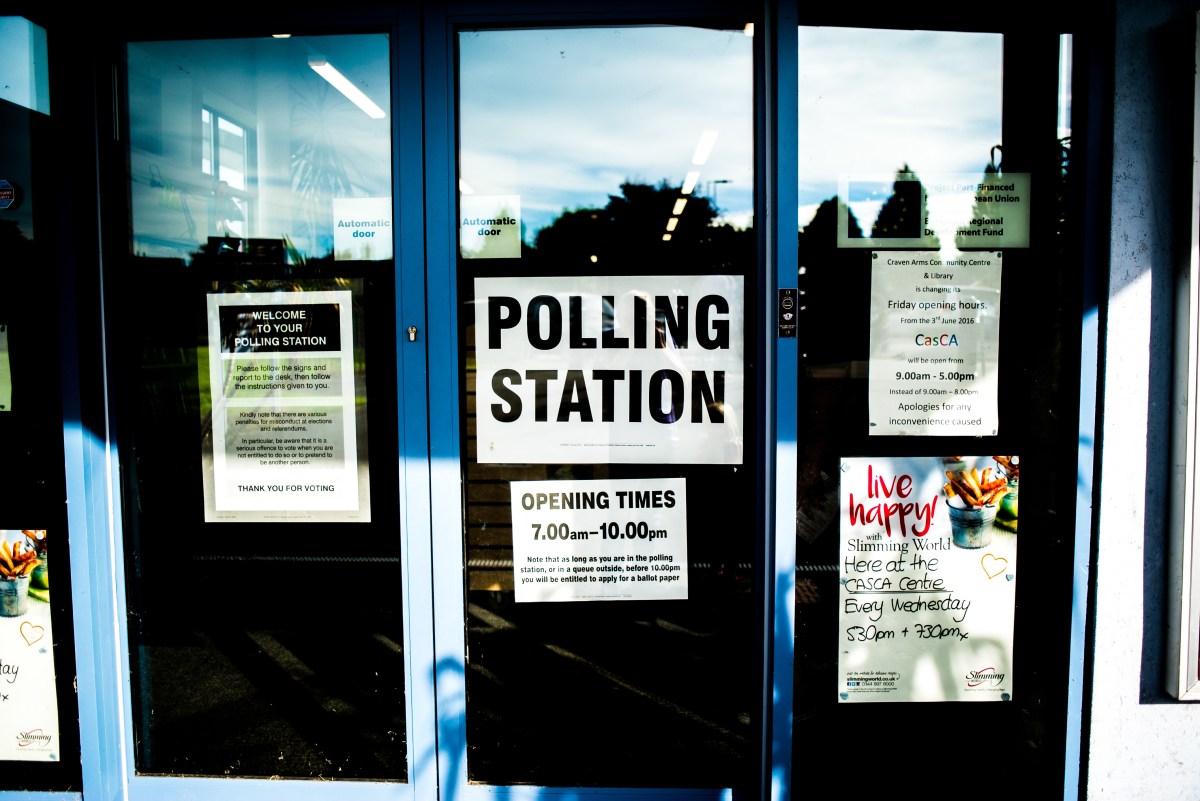
The Disinterest Disease

photo-1466780446965-2072a3de8a43
Elliott Stallion, photographer

Dear parents-who-are-not-voting-this-year,

I understand some of you are disgusted this election year. Your children tell me in my classroom you are so upset with the choice of candidates that you are not voting in this election.

Ok. I get that.

Let me tell you what’s happening. Your kids are shutting down in my social studies class. They don’t want to learn about the election. We had “Kids Voting” this week. Half the class shouted, “I don’t want to vote!” They are repeating very hateful phrases that I cannot believe you’d ever let them hear, let alone say.

This is uncharacteristic of my students. They usually want to engage in discussion of real life issues. They are always thirsty to express their thoughts, to learn, to analyze and participate. I’ve never seen them like this.

So I reminded them that people in some other countries (North Korea, for one) are not allowed EVER to vote. Your kids know about North Korea because I told them my parents were children during the Korean War and that they didn’t have access to a school or new shoes for at least six years of their childhood.  Many of our American children (my daughters included) are untouched by deprivation of basic needs: freedom, shelter, food. But not all American children are untouched by hunger, homelessness or hate. 

I reminded my students that millions of people have given their lives so that their children might vote. Voting is a right in America. If apathy continues to grow, it might become a privilege for just a few. It once was, you know, right here in America.

I encouraged instructed the class to log onto the Kids Voting website. I distributed access codes and told them to open another tab and look up words and issues if they did not know what they were. I told them to vote according to their beliefs. I told them there is no right or wrong answer. Beliefs are your own, like opinions.

They talked to each other, they looked stuff up. They talked some more. Not a single  argument. Friends disagreed, but remained friends. No one tried to talk the other out of anything.

It took 30 minutes for the students to research and vote on about 5 issues/positions.

When they were done, most were very pleased. “I finally know what an electoral college is!” I noted that the students who were not that enthusiastic were the ones who just guessed and voted. I know this because when I asked why some felt “Just OK” they answered, “Because I didn’t know what I was voting for.”

As an educator, it’s my job to ensure I teach your child to think critically. How can they do that if they shut down? Why would they think critically if they adopt a “what’s the use” attitude? Why strive to reach compromises for the Greater Good if you only hear hate?

Upon completion, they received an “I Voted” sticker. Remember those? Remember how proud you were to wear one?

Catherine* raised her hand.

“Mrs. Wipff, why can’t we all just have our beliefs and still be nice to each other, even with people who disagree with us?”

Indeed, why not?

*not her real name

Make Your Own Motivational Poster: Tip #9


The final tip Daniel Pink offers in his book Drive is to Create Your Own Motivational Poster. I know, it sounds lame, but I played around with it and it’s incredibly fun.

Try these sites:

http://diy.despair.com/

http://bighugelabs.com/motivator.php

wigflip.com/automotivator/

I made my Kismet poster using bighugelabs.com. It was very easy.

Try it!

Motivational Jump Starts: Tip #8

Here is a smart and simple exercise for assessing whether you’re on the right road to autonomy, mastery and purpose in your life from Alan Webber, Fast Magazine cofounder.

Get a few index cards. On one card, write your response to this question:What gets you up in the morning? On the other side of that card, write “What keeps you up at night?”

Keep each answer to one sentence. Stop when each gives you a sense of “meaning and direction.” Now you have something to use as your personal compass. Check in to see if they remain true. If not, ask yourself what you’re going to do about it.


Pink, D. H. (2009). Drive: The surprising truth about what motivates us. New York, NY: Riverhead Books.


Motivational Jump Starts: Tip #7

Daniel Pink’s Drive shows that mastery requires “deliberate practice” which is not simply consistency of work, but “very purposeful, focused and…painful” work.

Five steps to mastery:

  1. Deliberate practice includes changing your performance and setting new goals, not simply doing the same thing over and over again (Pink, 158).
  2. Repetition matters. “Basketball greats don’t shoot ten free throws…they shoot five hundred.”
  3. Seek constant, critical feedback.
  4. Focus on your weaknesses and how you can get better.
  5. Prepare for an arduously exhausting mental and physical process. This is why so few succeed. Not too many people commit this strongly. Will you?


Motivational Jump Starts: Tip #6

Tip #6 from Daniel Pink’s Drive cannot be overstated: Just say no. Pink informs us that management guru Tom Peters creates a “To Don’t” list. These items zap energy and time away from goals.

In today’s fast-paced, highly-distractable world, staying on point is an obstacle in and of itself.

“What you decide not to do is probably more important than what you decide to do.”

Tom Peters

Make a list of what detracts from your goals and work. Web-surfing? Netflix? Cleaning? Responding to emails? Don’t do it!

Motivational Jump Starts: Tip #5 (Daniel Pink)

Pink suggests that you get unstuck by “going oblique.” In the 1970’s, Producer Brian Eno and artist Peter Schmidt created a deck of cards that contained strategies to overcome stress and being “stuck” creatively. They called it “Oblique Strategies.”

You can purchase this deck of cards for $500 or used ones for $65 or you can get some great examples for free, here.

I think the bottom line is to “jolt” you out of your rut.

Maybe a deck of cards containing oblique strategies doesn’t do much for you.

For me,  visiting an art gallery or going to a live music event will inspire me to “break the walls” to creativity. Perhaps reading the biography of someone you admire will do it for you, or maybe a weekend trip to a cabin with no technology.

It will be different for everyone. Just make sure it’s in your arsenal of tools for work.


Motivational Jump Starts: Tip #3 (Daniel Pink)

After you ask the Big Question, you need to ask the small question:

“Was I better today than I was yesterday?”

Did you do more?

Did you do it well?

Monitoring day-by-day success ensures you will reach your goal long-term.


Source: Drive by Daniel Pink, pages 155-156


On Motivation (Daniel Pink) Tip #2

After identifying your “flow” activities and optimal times, Daniel Pink suggests strategy #2:

Ask a Big Question

Clare Boothe Luce (one of the first women to serve in Congress) advised John F. Kennedy to create his sentence. For example, Abe Lincoln: “He preserved the Union and freed slaves.”

One way to focus your life to serve a greater purpose is to create your sentence.

“He raised four kids who became happy and health adults,” is one example.

Or, “She taught two generations of children how to read.” (Drive, pg. 155).

What is your sentence?


Motivation (Daniel Pink) Tip #1

Tip #1 of 9 for Awakening Your Motivation: Give Yourself a Flow Test

In flow, people live “so deeply in the moment, and feel so utterly in control, that their sense of time, place, and even self melt away.”

If you haven’t identified what kind of activities engage you in this way, Pink suggests you set a timer for several random times throughout the day. When it goes off, record what you’re doing and how you’re feeling. You’ll soon find your “flow.”

This exercise can help you determine your optimal time of work and the “true source of your intrinsic motivation”!