Motivational Jump Starts: Tip #7

Daniel Pink’s Drive shows that mastery requires “deliberate practice” which is not simply consistency of work, but “very purposeful, focused and…painful” work.

Five steps to mastery:

  1. Deliberate practice includes changing your performance and setting new goals, not simply doing the same thing over and over again (Pink, 158).
  2. Repetition matters. “Basketball greats don’t shoot ten free throws…they shoot five hundred.”
  3. Seek constant, critical feedback.
  4. Focus on your weaknesses and how you can get better.
  5. Prepare for an arduously exhausting mental and physical process. This is why so few succeed. Not too many people commit this strongly. Will you?


Motivational Jump Starts: Tip #6

Tip #6 from Daniel Pink’s Drive cannot be overstated: Just say no. Pink informs us that management guru Tom Peters creates a “To Don’t” list. These items zap energy and time away from goals.

In today’s fast-paced, highly-distractable world, staying on point is an obstacle in and of itself.

“What you decide not to do is probably more important than what you decide to do.”

Tom Peters

Make a list of what detracts from your goals and work. Web-surfing? Netflix? Cleaning? Responding to emails? Don’t do it!

Motivational Jump Starts: Tip #5 (Daniel Pink)

Pink suggests that you get unstuck by “going oblique.” In the 1970’s, Producer Brian Eno and artist Peter Schmidt created a deck of cards that contained strategies to overcome stress and being “stuck” creatively. They called it “Oblique Strategies.”

You can purchase this deck of cards for $500 or used ones for $65 or you can get some great examples for free, here.

I think the bottom line is to “jolt” you out of your rut.

Maybe a deck of cards containing oblique strategies doesn’t do much for you.

For me,  visiting an art gallery or going to a live music event will inspire me to “break the walls” to creativity. Perhaps reading the biography of someone you admire will do it for you, or maybe a weekend trip to a cabin with no technology.

It will be different for everyone. Just make sure it’s in your arsenal of tools for work.


Motivational Jump Starts: Tip #3 (Daniel Pink)

After you ask the Big Question, you need to ask the small question:

“Was I better today than I was yesterday?”

Did you do more?

Did you do it well?

Monitoring day-by-day success ensures you will reach your goal long-term.


Source: Drive by Daniel Pink, pages 155-156


On Motivation (Daniel Pink) Tip #2

After identifying your “flow” activities and optimal times, Daniel Pink suggests strategy #2:

Ask a Big Question

Clare Boothe Luce (one of the first women to serve in Congress) advised John F. Kennedy to create his sentence. For example, Abe Lincoln: “He preserved the Union and freed slaves.”

One way to focus your life to serve a greater purpose is to create your sentence.

“He raised four kids who became happy and health adults,” is one example.

Or, “She taught two generations of children how to read.” (Drive, pg. 155).

What is your sentence?


Motivation (Daniel Pink) Tip #1

Tip #1 of 9 for Awakening Your Motivation: Give Yourself a Flow Test

In flow, people live “so deeply in the moment, and feel so utterly in control, that their sense of time, place, and even self melt away.”

If you haven’t identified what kind of activities engage you in this way, Pink suggests you set a timer for several random times throughout the day. When it goes off, record what you’re doing and how you’re feeling. You’ll soon find your “flow.”

This exercise can help you determine your optimal time of work and the “true source of your intrinsic motivation”!

Motivation: Daniel Pink

My co-workers and I discuss motivation of our students on a daily basis. So-and-So is simply unmotivated…if only he would find his motivation, he’s smart enough to pass, etc. We

teachers agree that we cannot give our students motivation. We can only inspire. But that’s often not enough.


Everyone has experienced the lack of motivation to create or pursue a dream. What is it that creates the “click”? The decision to act and work toward a goal?

Daniel Pink of Drive asserts that our businesses are operating under an outdated and unproductive system of carrots and sticks. Bonuses simply do not work long-term. What works, then? His research shows that there are 3 essential elements for enhancing motivation:

  1. Autonomy – “the desire to direct our own lives”
  2. Mastery – “the urge to make progress and get better at something that matters” and
  3. Purpose – “the yearning to do what we do in the service of something larger than ourselves.”

Essentially, extrinsic motivators do not work. Treats or rewards for good grades, reading books, practicing piano…they can actually undermine intrinsic desires.

Tomorrow, I will cover the first of nine strategies Daniel Pink identifies to awaken your motivation.


Self-Publishing for Newbies

While I wait for my illustrators (daughters, 13 and 14) to submit more art, I’ll tell you how I created my first draft of Esther, Mia and the Stars (a book about a girl who gets bullied and how her best friend and school helped her).


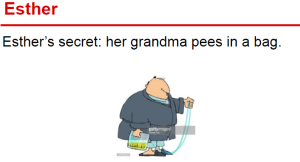
esther_grandma_pees
PPT slide with placeholder (Ava created a much better graphic).

I created the story line and broke it down by “scenes.” Each scene then got its own Powerpoint slide. I know…PPT is BORING. It’s passé. But it was for my eyes only. It helped me visualize the book and run through it quickly. I could drop kick each illustration (or placeholders) easily. This helped me “see” the book readily and troubleshoot quickly.


Tip: Consider  using Google Slides.  This way, you’ll have access to your project wherever you go and you won’t lose it!