4 Ways to Creative, Financial Freedom

I have been following Deep Space Sparkle  by Patty Palmer for years. I’ve watched her grow from an art teacher writing about her passions to a full-fledged entrepreneur with one of the most generous websites I’ve ever landed on.

Yesterday, I told you about Teachers Pay Teachers, a website where you can post your hard-earned work and start getting paid for it. Patty has created her own website and offers curriculum for sale (as well as a lot of FREE valuable resources).

deepspacesparkle

In her latest podcast, she reviews and shares her successes as a teacher and businesswoman. Teachers are some of the most creative, loving people you will ever meet, but it’s hard for them (us) to ask to be paid what we’re worth. Here are some of Patty’s tips for success while leaving your love of teaching intact:

  1. Enjoy – really enjoy – your teaching right now. Use this opportunity to experiment with your students…see what works. Bring your best each and every day.
  2. Start selling slowly. Use Teachers Pay Teachers, or start your own website. Don’t quit your job to do it, just begin.
  3. Create your curriculum based on your passions, don’t look to children or their parents for direction.
  4. Learn new skills! Have fun as you learn. It’s never too late.

One (of many) things I love about Patty’s site is that she emphasizes the importance of living and loving the present moment. This is what Kismet is all about. The paradox of success: In order to “get there”, you need to “be here.”


2 Quick Tips for Self-Publishing and Entrepreneurship

As my illustrators get to work, I want to apprise you of two valuable resources for self-publishing and entrepreneurship – especially if you’re a teacher – but for everyone.

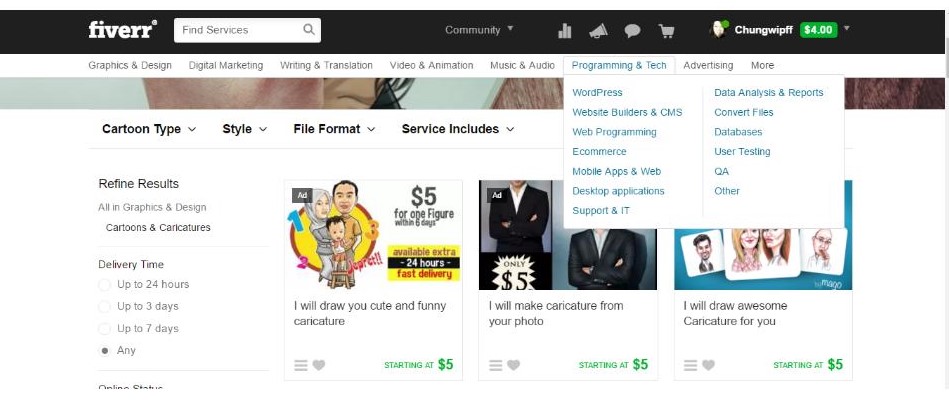
Tip #1: Fiverr.com– Here, you can find every possible digital need: marketing, video animation, programming, singer-songwriters and translation work. Each gig starts at $5. You can also sell your services here.

Here is what you see when you browse for “Cartoon & Caricatures”:

for-blog-2-tips-10_2_16-2

You can communicate with artists before making a decision. All you need to do is agree upon a deadline and price and then wait.  I used an artist who lives in Germany. I just needed cover art for a short story and she did a fantastic job…for $5! Providers are given reviews to hold them accountable for delivery time and customer satisfaction.

Tip #2:  Especially for teachers – is TeachersPayTeachers.com Here, you can find high-quality lesson plans  and activities for your grade level and subject matter. Almost all material has been created by teachers. Again, providers are reviewed by customers and everyone strives to attain a 4.0. There are teachers on this site who are so good, that their pay from TpT equals or exceeds their teacher salary!

Here is the Halloween page:

untitled-drawing


Selling your work is free and easy. They have ample tutorials and advice to help you be successful. If you sell a lot, it’s recommended that you go to “premium” status, which costs you about $60/year, but you’ll get a higher percent of your sales.

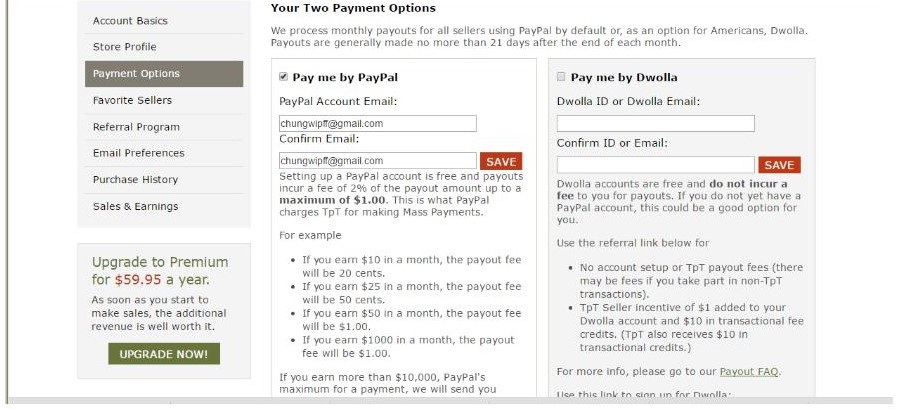
Here’s the breakdown for getting paid via PayPal and Dwolla:

tpt_payment

Here’s to creating, learning, teaching and prospering!

Make Your Own Motivational Poster: Tip #9


The final tip Daniel Pink offers in his book Drive is to Create Your Own Motivational Poster. I know, it sounds lame, but I played around with it and it’s incredibly fun.

Try these sites:

http://diy.despair.com/

http://bighugelabs.com/motivator.php

wigflip.com/automotivator/

I made my Kismet poster using bighugelabs.com. It was very easy.

Try it!

Motivational Jump Starts: Tip #8

Here is a smart and simple exercise for assessing whether you’re on the right road to autonomy, mastery and purpose in your life from Alan Webber, Fast Magazine cofounder.

Get a few index cards. On one card, write your response to this question:What gets you up in the morning? On the other side of that card, write “What keeps you up at night?”

Keep each answer to one sentence. Stop when each gives you a sense of “meaning and direction.” Now you have something to use as your personal compass. Check in to see if they remain true. If not, ask yourself what you’re going to do about it.


Pink, D. H. (2009). Drive: The surprising truth about what motivates us. New York, NY: Riverhead Books.


Motivational Jump Starts: Tip #7

Daniel Pink’s Drive shows that mastery requires “deliberate practice” which is not simply consistency of work, but “very purposeful, focused and…painful” work.

Five steps to mastery:

  1. Deliberate practice includes changing your performance and setting new goals, not simply doing the same thing over and over again (Pink, 158).
  2. Repetition matters. “Basketball greats don’t shoot ten free throws…they shoot five hundred.”
  3. Seek constant, critical feedback.
  4. Focus on your weaknesses and how you can get better.
  5. Prepare for an arduously exhausting mental and physical process. This is why so few succeed. Not too many people commit this strongly. Will you?


Motivational Jump Starts: Tip #6

Tip #6 from Daniel Pink’s Drive cannot be overstated: Just say no. Pink informs us that management guru Tom Peters creates a “To Don’t” list. These items zap energy and time away from goals.

In today’s fast-paced, highly-distractable world, staying on point is an obstacle in and of itself.

“What you decide not to do is probably more important than what you decide to do.”

Tom Peters

Make a list of what detracts from your goals and work. Web-surfing? Netflix? Cleaning? Responding to emails? Don’t do it!

Motivational Jump Starts: Tip #5 (Daniel Pink)

Pink suggests that you get unstuck by “going oblique.” In the 1970’s, Producer Brian Eno and artist Peter Schmidt created a deck of cards that contained strategies to overcome stress and being “stuck” creatively. They called it “Oblique Strategies.”

You can purchase this deck of cards for $500 or used ones for $65 or you can get some great examples for free, here.

I think the bottom line is to “jolt” you out of your rut.

Maybe a deck of cards containing oblique strategies doesn’t do much for you.

For me,  visiting an art gallery or going to a live music event will inspire me to “break the walls” to creativity. Perhaps reading the biography of someone you admire will do it for you, or maybe a weekend trip to a cabin with no technology.

It will be different for everyone. Just make sure it’s in your arsenal of tools for work.


Motivational Jump Starts: Tip #3 (Daniel Pink)

After you ask the Big Question, you need to ask the small question:

“Was I better today than I was yesterday?”

Did you do more?

Did you do it well?

Monitoring day-by-day success ensures you will reach your goal long-term.


Source: Drive by Daniel Pink, pages 155-156


On Motivation (Daniel Pink) Tip #2

After identifying your “flow” activities and optimal times, Daniel Pink suggests strategy #2:

Ask a Big Question

Clare Boothe Luce (one of the first women to serve in Congress) advised John F. Kennedy to create his sentence. For example, Abe Lincoln: “He preserved the Union and freed slaves.”

One way to focus your life to serve a greater purpose is to create your sentence.

“He raised four kids who became happy and health adults,” is one example.

Or, “She taught two generations of children how to read.” (Drive, pg. 155).

What is your sentence?