One New Habit: A New You

We’re still 87 days to New Year’s (but who’s counting)?

Maybe you get excited about setting resolutions. Maybe you are thinking of how you are FINALLY going to change…lose weight, make/save more money, get a new job/spouse/partner.

Or maybe not. Maybe you’ve tried and failed so many times, you’ve given up.

If you are serious about reaching your goals, then you need to develop healthy habits. It’s the things you do on a daily basis that ultimately lead to the actualization of your dreams. Crash diets don’t lead to long-term weight loss. Superficial makeovers don’t lead to marriage and a lottery ticket won’t make you rich (your chances: 1 in 14 million).

It’s going to take change on a daily basis. But it doesn’t have to be painful.

Charles Duhigg of The Power of Habit discusses the surprising power of developing a small habit. He found that people who formed a small, healthy habit usually developed other strong, healthy habits.

For example, I know someone who decided to see if drinking 64 oz of water every day would get rid of her under eye circles. She drank at least 64 oz of water every day for six weeks. She didn’t notice a difference with the dark circles (dang it!), but she did notice that she was eating healthier foods and exercising more regularly which led her to sleeping better.

Duhigg was right!

What small, healthy habit can you begin today?


Friday’s Nitty Gritty

Get-Rich-Quick Schemes

Crash Diets

New Year’s Resolutions


These don’t work. There’s no way to reach lofty goals except to work hard.  In fact, exceptional goals all require one factor: Grit.

Angela Duckworth coined the term when she distinguished the difference between her 7th grade public school math students who excelled those who didn’t. She also noticed this difference between her colleagues and herself – some of her co-workers had become experts over 20 years studying the same subject. Although she was always achievement-minded, Duckworth felt her work was much less focused on any one area. She defines this special characteristic “grit” – “a passionate commitment to a single mission and an unswerving dedication to achieve that mission.” (Paul Tough, How Children Succeed)

Duckworth created a 12 question grit survey. Answers to questions such as: “New ideas and projects sometimes distract me from previous ones” were answered by a 1 to 5 point scale responses (1 = not like me at all to 5 = very much like me). Although the surveys were self-administered, they found the results to be quite accurate and indicative of future success. In fact, they administered it to 1200 military cadets at West Point. Out of several other tests used to predict graduation rates, Duckworth’s 12 question survey was the most predictive.

Why does this matter? Perhaps because so much has always weighed on IQ or “intelligence.” If one can harness the power of grit, one can achieve anything.

IMG_1331
An Ava Wipff Creation  7/1/16


Writing Accountability

Having a hard time getting regular about writing?

Natalie Goldberg suggests you hook up with a fellow (local) writer. Tell her/him that you’ll meet ’em at the local coffee shop at 3pm. When they say they can’t meet, stop them and say, “No, no. I don’t want to know whether you’ll be there or not. I will go and write whether you’re there or not.” You continue this way: email, text, call your friend and make a writing date and keep it no matter what.

natalie

You could also blog or publish your work every day and tell everyone you know that you’ll be publishing daily. Believe me, there’s nothing like being held publicly accountable!

Seth Godin has excellent tips on doing this. In fact, I started writing my blog again (following a long absence) after reading about his philosophy. Godin encourages you to write every day – even badly – because it will get your brain working to think crisply, analytically, every day. You notice things more. He’s right!

seth godin

And if that monkey mind starts to chatter (“This isn’t good… people won’t like this, etc.”) tell that monkey that it is far easier to criticize than to create!

Tear It Down In Order to Build It Up


FullSizeRender.jpg
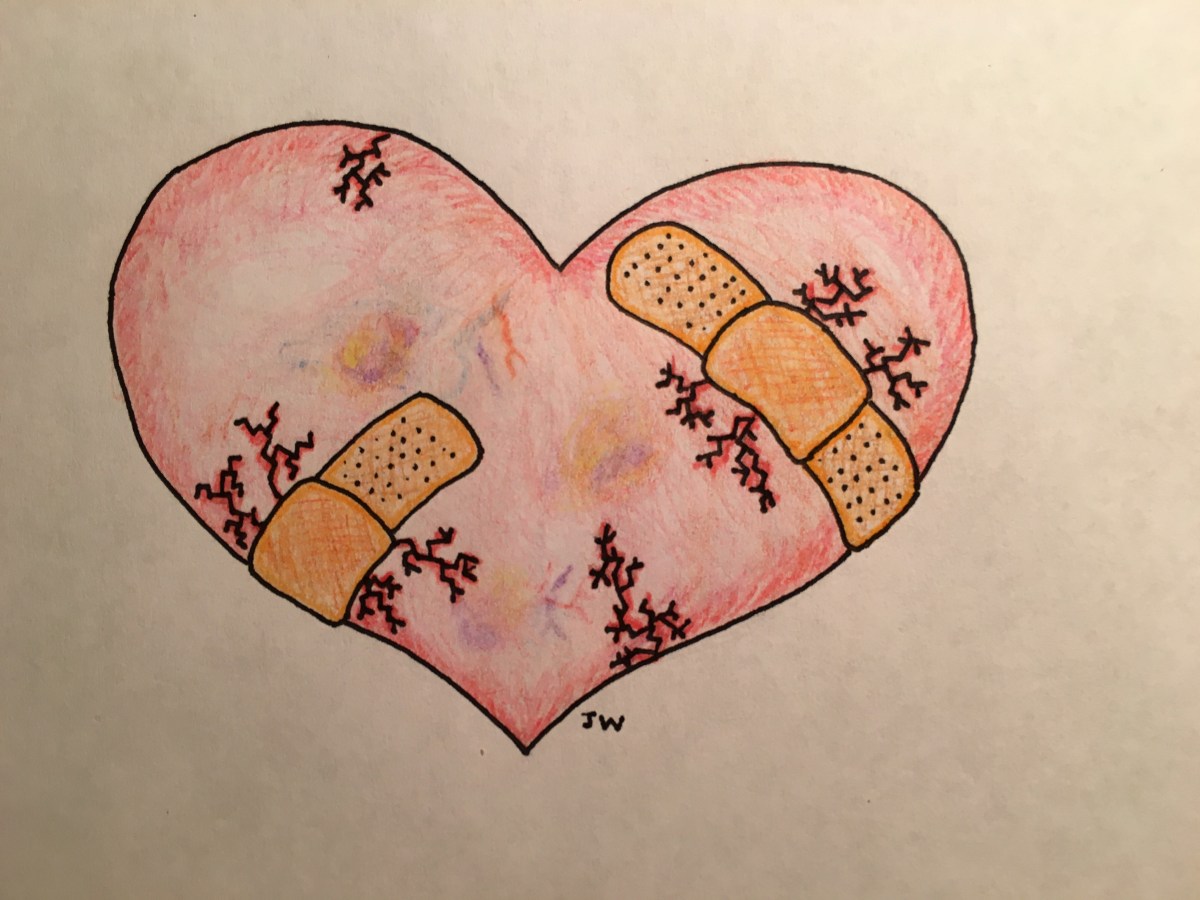
“Swollen Heart” by Josie Wipff, age 14 (6/18/16)

In order to build your dream house, you might have to destroy the dilapidated building that stands on the property first. You have to clear the area. And then you build. You have to spend money, hire people to help, do some problem-solving, tear some hair out…but in the end, it’s built.  And your dream comes true.

When you want to increase muscle in your body, you have to lift heavy weights. This hurts. I guess that’s why so many people don’t do it. But when you tear those muscles, your body works to build them up again – stronger. And you can lift things you couldn’t lift before. And you feel good and you look good and your lover/spouse can’t keep his/her hands off of you. Hm, might be worth the pain?

There are people who are working hard at a relationship that brings more tears than laughter. “Well, I’ll forgive so-and-so again, he/she didn’t mean to hurt me, etc.” They spend their precious time trying to make the other person into someone he/she isn’t. They invest their energies only to be disappointed time and time again. They hope he/she won’t yell/hit/stay out late/do drugs/get drunk anymore. But their partner isn’t changing. Some major tearing down and clearing is necessary in order for something special and amazing to be built.

What do you need to destroy and clear out before beginning again?


Even if You Don’t Want To…

One of my summer school students – I’ll call her Liliana – was woefully deficient in her math skills. Going into 5th grade this year, she should be prepared to work math problems with fractions. However, she was still struggling with simple addition and multiplication. After working intensely for over a week, she grasped basic multiplication quickly.

After successfully solving four multiplication problems, I told her, “OK, you’re ready for division.”

Her eyes grew large. She stepped back from me. “No, not yet.”

“Liliana, you’re ready.”

“Just one more.”

“No, you’re ready. What’s the matter?”

She just stood there, silent.

“It’s ok if you make mistakes at first. That’s how you learn. Look how far you’ve come!”

She looked at me doubtfully. I gave her a problem to sort out, after working one through for her.

She returned with her work. She had made one small mistake. Her brows were furrowed. She was looking at her mistake.

Yet she had successfully worked out several steps correctly before that.

“Look at how far you came, Liliana! Look at how many steps you got right. Focus on that. And now, study your mistake. This is learning.”

She’s still working on division. It will take time. But you and I know that  if she’s determined and works consistently, she will master it.

How many times do we shy away from the next step? How many times do we say, “Not yet”? And how many times do we focus on our mistake and not our successes?

Take that next step, even if you don’t want to.


Tiebacks

cactus with tiebacks
Our Ocotillo

We’re growing various plants in our backyard, including an herb garden and, of course, cactus. My favorite desert plant is the ocotillo. I see them growing magnificently in Usery Park (where they grow wildly and without irrigation) but in my own backyard, it’s taking its time. We don’t want the branches to grow out into the pathway, so we placed tiebacks on the branches to “encourage” and “redirect” growth in our desired formation.

Tiebacks work when the plant is still supple and maturing, and the tiebacks are gentle in their support. It wouldn’t work to have harsh restraints which could harm or kill parts of the plant.

Humans have tiebacks, too. They’re called habits. As with plant tiebacks, they’re most effective when we’re receptive and “supple” and when the habits are firm, but not too harsh.