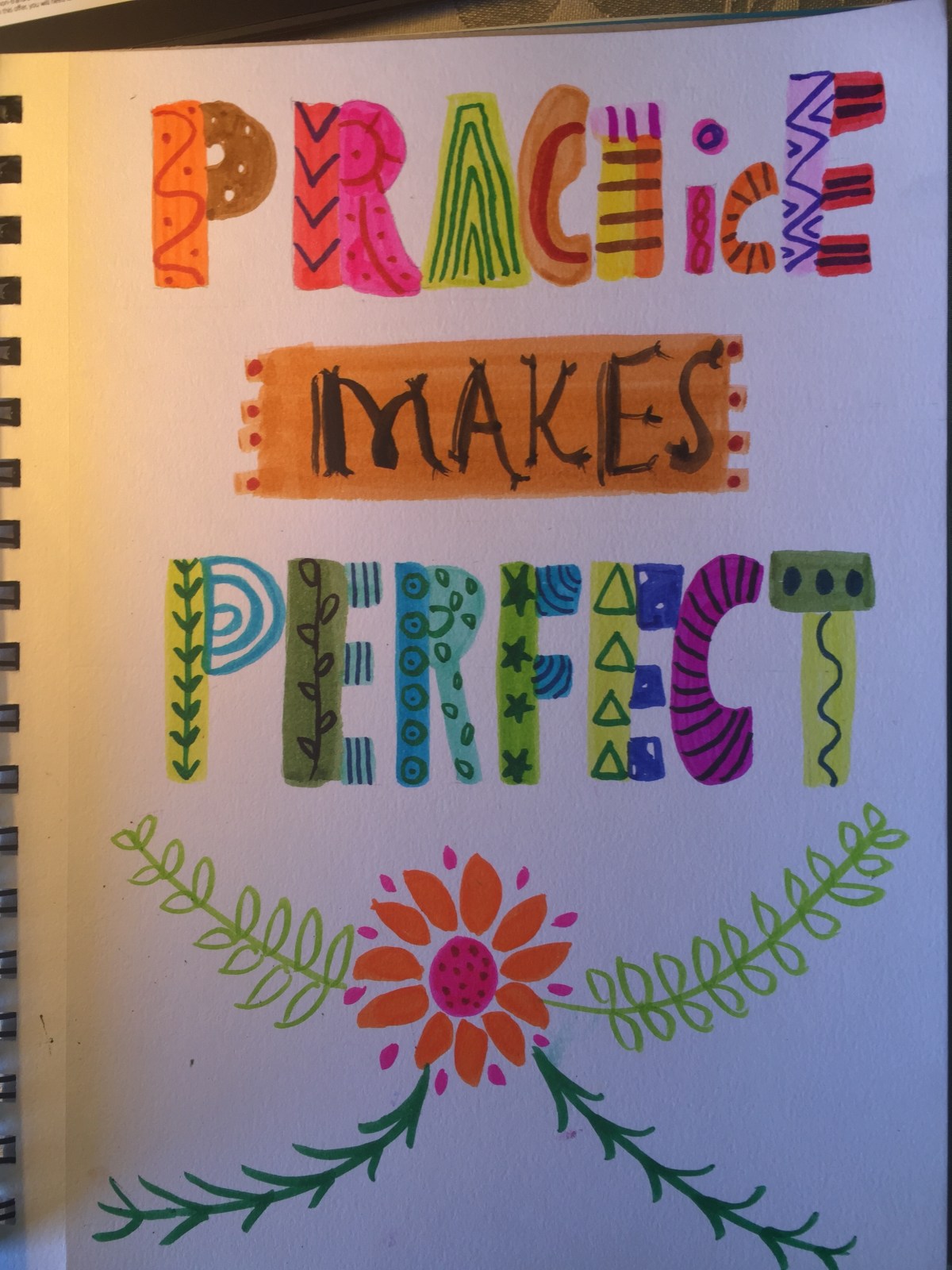
Actually, I believe “Practice makes permanent” is more accurate.
Practicing with the aim to improve means practicing with presence each time.
Actually, I believe “Practice makes permanent” is more accurate.
Practicing with the aim to improve means practicing with presence each time.

“The range of what we think and do is limited by what we fail to notice. And because we fail to notice that we fail to notice, there is little we can do to change; until we notice how failing to notice shapes our thoughts and deeds.”
R.D. Laing

Elizabeth Gilbert, American Author
“Perfection is the death of all good things, perfection is the death of pleasure, it’s the death of productivity, it’s the death of efficiency, it’s the death of joy. Perfection is just a bludgeon that goes around murdering everything good. Somebody once said I was disingenuous for saying this, because surely I try to make my work as good as it can be. And that’s absolutely true — but there’s a really big difference between ‘as good as it can be’ and perfection.” – TED, September 2015

Yesterday, I was in my leadership class again. My instructor – a highly esteemed retired high school Principal – handed us four packets of interview questions. There must have been 700 questions in there. We started going over a few and discussing possible answers.
I don’t know about you, but just the thought of interviews makes my palms sweat.
I felt really, really nervous at the prospect of having 10-12 people around a table asking me 20 questions. And then he said,
“If you’re really nervous before you go in, you’re not prepared.”
Yes. I knew this to be true. Sure, butterflies are normal. This is your body’s way of preparing you to be on your toes. But the shaky, can’t-think-straight nervousness you feel before you have to perform?
You’re not ready.
So whatever you’re preparing for, work it. Work hard. Put in your hours, your sweat, blood and tears. Do the research, or the workout or the practice. Give it all you’ve got and then surrender.
*Maya Angelou tip: Think of all the people who have ever loved you and the people around who love you now. When you go in for the interview, get on that stage, or go in the boxing ring, call all your loved ones to accompany you.

One of the 5 ways to increase your grit is practice, practice, practice. By this, Angela Lee Duckworth means to practice deliberately. For example, let’s say you’re a musician. It might be tempting to play that piece that you know so well, the one everyone compliments you on. But you’re not going to get better by doing that. You need to practice that four octave scale you haven’t nailed yet. You need to go slowly, hit each not just right and start over when you get it wrong. Boring! Tedious! But so critical.
This is grit.
It’s hard and it’s boring and you need to do it every single day. You need to be consistent.
That is how you get better.
By the way, you can substitute anything for practicing violin: football, soccer, dance, writing, drawing, painting. If it’s worth doing, it’s worth doing extremely well.
Trying to lose weight?
Want to step up your work performance?

The importance of developing excellent habits in order to reach lofty goals is well-known. However, James Clear and Charles Duhigg (The Power of Habit) have studied the efficacy of habit-making and, after reading their work, I found 2 findings especially enlightening and helpful:
Clear admits that although the (commonly held) belief that it takes 21 days for a habit to hold sounds better than 66, it’s actually inspiring to know that it takes longer. If you “fall off the wagon” within the 21 days, you know that you haven’t failed. You just get back up and continue the work.The habit hasn’t formed permanently yet. Don’t give up!
Personally, I feel a difference between saying “I want a,b,c, to be a new habit” vs. “My rule is a,b,c.” It feels permanent and there is no wiggle room.
 Kismet