I’m Glad I Asked

He came in the second day without his backpack.  I resisted the urge to roll my eyes and sigh. How can a 5th grader forget his backpack? Didn’t he feel like something was missing? 

Instead,  I asked him to walk me through his morning. Maybe I could help him.

“I pack my things and walk to the garage.  I put my backpack down and get my little sister.  Then I strap her into her car seat. I guess I forgot to get my backpack. ”

My irritation became empathy and respect. 

This illustrates why judging others can be harmful – to others and ourselves. We each have our own cross to bear.

Clean Up!

catt-liu-1624.jpg

A group of Taiwanese elementary school students came to visit our school today. They wanted to play music for us and see how Americans learn in school.  Because our students learn some Mandarin, they were able to communicate – a  little bit – with each other. It was a wonderful cultural exchange.

One thing we learned is that these Taiwanese students dedicate some time in their week – every week- to clean their school!

Other schools clean up after themselves too. Here is an article about Japanese schools that dedicate time to housekeeping.

“The practice, which starts when students are in first grade and continues right through high school, involves floor dusting, furniture moving and cleaning the hallways.”

Mic.com

The rationale makes sense: if students are personally obligated to keeping their school clean, they will treat it with more respect all day, every day.

I wish our public schools did this. I see students scuff walls with their shoes and our custodians complain that students urinate on the floors on purpose!

“Not Knowing” Is OK

kbhb_tfbnua-mike-petrucci.jpg

I gave my 5th graders a writing assignment today. I already knew what they’d say after our poetry lesson and the directions. “I don’t know what to write about!”

Literally, I had to turn away ten students from my desk. They are so frightened to face a blank piece of paper and not know “the answer” immediately. They wanted me to tell them what to write.

I found myself saying, “It’s OK to sit in anguish.” I was joking, of course, what I meant was,

“It’s OK to sit without knowing.”

You don’t know what will happen tomorrow.. You don’t know what you’ll be when you grown up. You don’t know who you will marry (or if you will)!

So sit with not knowing. Be quiet and still. Let it come to you.


Don’t Overestimate the Power of Review


Sentence-diagram-conjunction-independent.png

A couple weeks ago, I taught my 5th graders how to diagram sentences. We started out very simple. They liked it, because it was kind of like geometry in English class. Basically, students were to separate the subject from the verb and create dangling shelves for modifiers. After practicing ten sentences, we started our literature study and left diagramming off to the side.

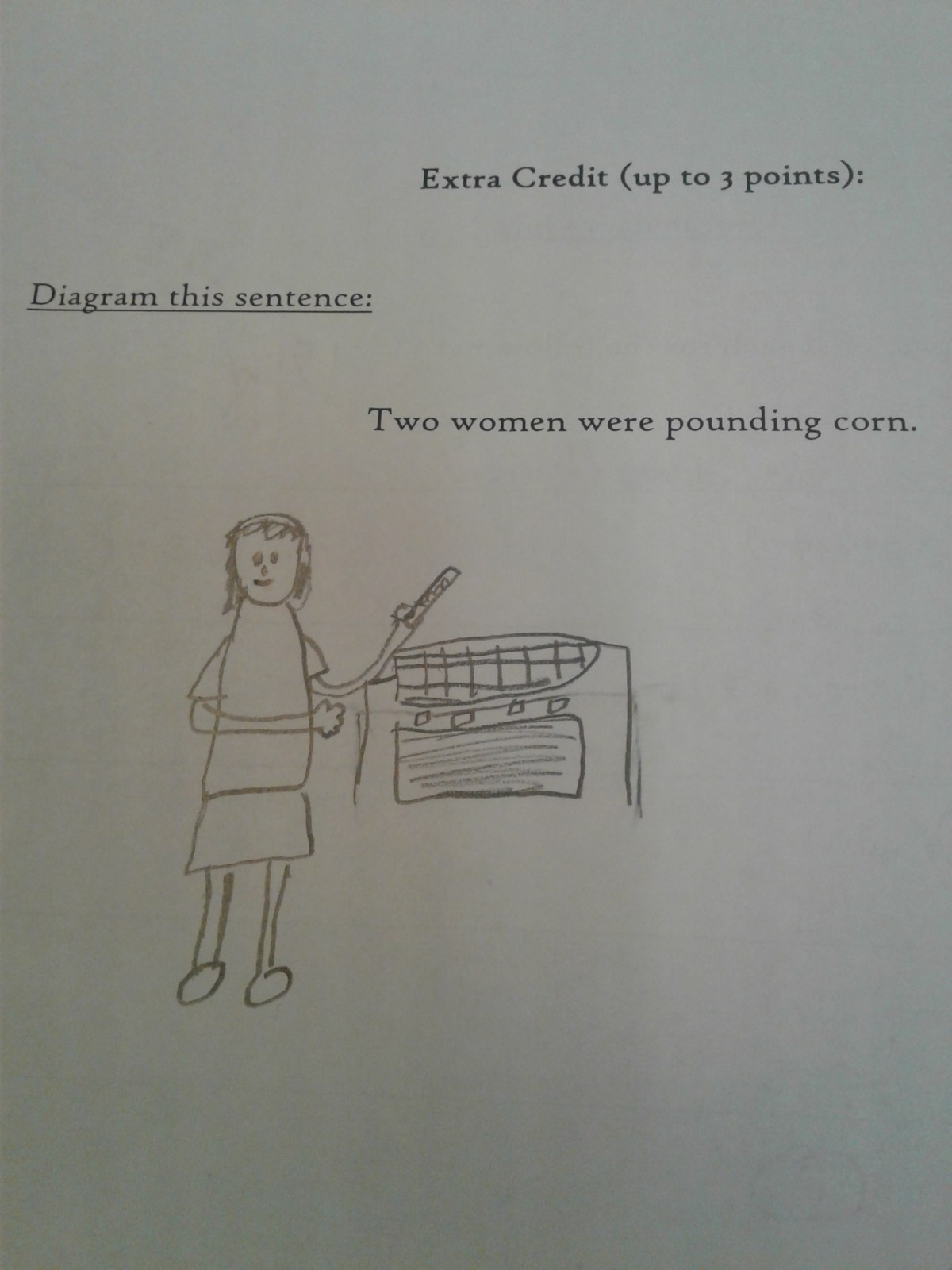
On their vocabulary test today, I decided to be generous and offer extra credit for diagramming a very simple sentence related to our literary study, The Sign of the Beaver. Here are two responses:

20170113_155937.jpg

Where’s the other woman?


20170113_160301.jpg

I’m speechless.


Whirlybird Lunacy

lhsgbavacws-antonio-lapa.jpg

There is a label, in the education field, for parents who “hover” over their children in an overprotective, and micro-managing way: helicopter parenting.

As teachers, we get it.  You don’t want your child to ever “fail.” You want to prove to your child, the world, your self, that you are an involved parent. But you are not doing your child any favors.

When you hover, you:

  • subconsciously tell your kid that you don’t trust him to do it himself;
  • create anxiety for your child;
  • cheat your child out of the opportunity to work independently;
  • cheat your child out of learning from failing; and
  • cheat your child out of accomplishing something on his own.

 Sometimes, effective parenting means surrendering.


5 Ways to Increase Grit

p_6ukcsylns-christian-rosswag.jpg

Grit – the persevering drive to achieve one’s goals – is identified as one of the most powerful factors for success, even more than talent.

A big part of my job is to preserve perseverance in my students. As a mother, modeling and maintaining grit is central to my parenting style. We can raise talented, very smart children, but without resilience, they won’t create and maintain satisfying, successful careers and lives.

Perhaps you’ve found your own passion and you can relate. “I love writing/painting/coding/etc. but I often fail to complete a project. How can I develop grit?”

Angela Duckworth, a noted psychologist, author and recipient of the MacArthur Genius award for her work on grit, identified 5 research-based ways to increase your grit level:*

  1. Pursue your interests – obviously, if you’re intrinsically driven to pursue something, you’ll be more apt to stick with it through thick and thin!
  2. Practice insanely – consistent, deliberate practice not only makes perfect, it also increases your perseverance.
  3. Find purpose – if your long-term objective is to help your community or others, you’re more likely to stick with the work than if your objective is to save up for that dream Ferrari.
  4. Be optimistic, have hope – truly believe and expect that tomorrow will be better than today. So if you’re still learning and making mistakes, know that you’re just going to get better and better.
  5. Join a Gritty Group – Have you heard the saying, “You’re the average of the 5 people you spend the most time with?” It’s true. Stick with diligent people and you’ll be persevering too.


*Source:  http://theweek.com/articles/624204/5-researchbacked-ways-increase-grit


A 10 Year old Says…

photo-1471914036897-d8255336ca8a


One of the questions on our last 5th grade social studies quiz was, “How can we, as Americans, ensure equal rights for everyone?” This was on the heels of learning about slavery and the Civil Rights Movement (literary study: The Watsons Go to Birmingham).

Most of my students answered, “Treat everyone like we’d like to be treated,”  or “remind everyone about the Constitution.”

But one student wrote:

We could start an activity or sports program where EVERYONE was invited. People of all races would play together and while they played and made friends with each other, they would see we are all the same and racism would be gone.


If you’re feeling discouraged, by recent racist rhetoric from a small group of small-minded people, remember there are a lot of good people out there. Our children are wise.

Filters

photo-1458872590620-5056e3311cad-1

When you are in the presence of a person who speaks his mind freely, spontaneously and thoroughly (often inappropriately) we say, “He has no filter.”

This is often a problem in the classroom when there are 34 students and the teacher has numerous goals she wants to achieve. The outspoken person not only takes up valuable time uttering words that have little to no value, but it can distract other students and take them off-task.

It often causes drama.

That student can filter his words, but it requires self-awareness and self-discipline.

We can ALL filter our minds. We are in control of what we choose to read. We are all, each, in control of who we socialize with and, to some degree, who we engage with at work. You can choose to read the news and get upset or, you can choose to opt out.

But how will I stay informed? How will I continue to participate in my world?

To which I ask, “Are you truly engaging and participating in the world when you read what inflames you and then complain about it?” How about doing some volunteer work? How about starting a rights group? How about writing letters to your state representatives?

There will things you see or hear that you do not like. This is when space is helpful.

Filter your world carefully and you will see a change for the better.


Your Purpose Relies on Community

busybees

Because I work with children all day (super busy bees!) and have two children of my own, daydreaming about solitude occurs from time to time. To be alone! Ahhhhh!  To stand in silence. I dream.

quiet

But it is within community that we find meaning in our lives and our work. You might work alone, but your work inevitably touches people. If it doesn’t, it’s not of value.