 Summer break is about two weeks away and I’m building my summer reading list. I just received my copy of Marcus Aurelius’ “Meditations”.
My goal is to read a little of each genre. Have you read something you can strongly recommend?
Summer break is about two weeks away and I’m building my summer reading list. I just received my copy of Marcus Aurelius’ “Meditations”.
My goal is to read a little of each genre. Have you read something you can strongly recommend?

I was driving home and stopped suddenly – a mother quail ran across the street, with her 7 babies running right behind her. A family of quail is usually bookended by parents. After my car passed them, the daddy quail quickly crossed the street and caught up with his family.
Unfortunately, baby quail have an 85% mortality rate. They can’t fly for about 11 days after birth and predators are all over the place. Be safe, little ones!

My husband is a project manager for a commercial construction company. I’m a 5th and 6th grade English teacher.
This morning, over coffee, he says, “Some of my clients seem to think we work magic.” [He was about to complain about their unreasonable demands.]
“Some of our clients seem to think the same thing,” I say.

I’ve discussed my trials and tribulations parenting teenagers here and here and…everywhere.
I had a breakthrough today. If you’re reading this and you’re a perfect parent, well, you won’t be impressed in the least. Maybe I’m a slow learner. But this is a true story.
I was walking today and listening Eckhart Tolle. I know some of you think it’s all self-help crap and I’m a lost soul…but I have become a better person for it. Anyway, in this particular recording, Tolled talked about the importance of of “space” and “non-reaction.”
The goal, he says, is to feel at peace. At all times.
Just then, my daughter texted me. “—— can drive me to you.”
“Great,” I respond.
“I need to go home and change and do my makeup and then I need to be back at school by 6:15,” she texts.
“Can —– drive you home?” My boss had a retirement party this afternoon. It’d be quite challenging to drive back and forth.
Tolle continues to talk about the importance of space and non-reaction. If you can, create space between yourself and the angry person.
She calls me. I answer. Good, texting is dumb, anyway.
She talks to me in an angry voice. I can hear a bunch of teenagers trying to talk to her. She gets angry at me because I can’t understand her – she’s talking to me, she’s talking to them…I’m confused.
I ask her (again) if —- can drive her home.
She responds with sarcasm and anger. She sighs heavily, as if it’s so hard to have me as a mom. She talks to me as if I’m stupid. Her words become staccato with anger. I. told. you.
I hang up.
She texts me with more anger. Her answers include expletives. How dare I hang up on her!
I text back with: “If you think you’re going to talk to me that way, you’re out of luck.”
I’m proud of my lack of emotion. I feel the anger, but I refuse to react. Eckhart has my back.
Tolle continues, “Someone may even yell at you and you want to yell back, but don’t.” It’s as if he’s walking with me!
So I don’t. I don’t react. I want to, believe me. I want to remind her whose the mom…but I’ve been down that road before and it never works.
It never pays to engage with her rage.
Long story short, she tried to involve me in an argument. She wanted to place blame. She wanted to excuse her horrible behavior and blame me. I stop her. I re-direct her to make a plan. We make the plan. We execute.
Later, she apologizes. She has not apologized in a very long time…months, even.
We hug.
I see many painful moments in her future. She will have to learn the hard way, she always has. But that’s OK. I’ll be here.
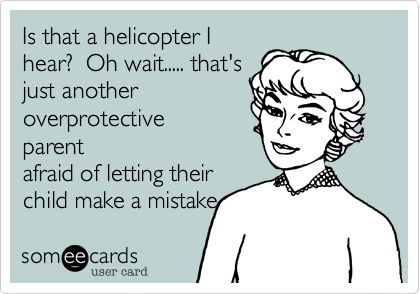
Helicopter parent –
Constantly hovering over children while they study, work, and do sports, etc. has been shown to “increase anxiety, depression and can lead to academic difficulties” (Psychology Today).
Effective parenting, is, in fact, nurturing your child to become independent!
Psychology Today offers these guidelines (abbreviated):
-Listen to your child, rather than imposing your goals and wishes on him or her. Listening to your child encourages independent thought and critical thinking. It helps you avoid a common downfall of helicopter parents: imposing your values on your child.
-Don’t manage your child’s relationships or communications for him or her.
-Don’t try to help your child escape consequences for his or her actions, unless you believe those consequences are unfair or life-altering. It’s fine to hire your child a lawyer if he or she is in legal trouble, or to intervene with a bullying teacher. But don’t try to get your kid out of detention or berate another parent who talks to your child about problematic behavior.
-Don’t raise your child to expect treatment that is different from, or better than, the treatment other children receive. Your child shouldn’t expect to get something they don’t deserve or didn’t earn.
-Encourage your children to solve their own problems by asking them to contemplate potential solutions.
-Don’t do your child’s work for them, or keep track of deadlines for them. Even school-aged children can learn to remember test dates and classroom projects. By middle school, your child should be managing their schoolwork largely on their own, with only as-needed help.
-Support your child’s teacher, and encourage your child to respect the teacher’s opinions.
-Allow your child to face natural consequences for their actions. Don’t allow a child to stay home sick just because she or he didn’t timely complete a school project.
*Eric Hoffer was a great American thinker and he never actually said anything about helicoptering parenting. It just rhymes nicely.

When I was eight years old, my teacher, Ms. Meretta, told my mother I was one of the hardest working kids she had ever had. Until then, no adult had ever said anything positive about me. Really. My parents were concerned that I showed no genius academically. They compared me to other kids (always unfavorably). My other teachers were either distracted by personal problems, or they just seemed mean (maybe they weren’t, but they seemed unapproachable). One teacher said she liked me, but I rushed through my work too quickly to get to the “book table.” I liked reading too much.
I loved Ms. Meretta. I worked even harder after her comment to my mom. But this time, I worked hard not just for myself..but for Ms. Meretta, too.
When I was a young adult, I worked as a summer camp counselor for the YMCA. It was a fun and rewarding job. I loved the energy the kids brought each day. I loved thinking of fun activities and working with them. I laughed every day. I laughed every hour.
I’ve held different jobs but none have had the creative opportunities or the intrinsic rewards of teaching. One of my favorite gifts from a student was a short letter. I had recommended him to go to a school for high-achieving students. He had older siblings who attended a school closer to his home. He always assumed he’d follow their footsteps. It was easy to hold the fastest track time there. It was easy to be the best student. I told him I knew he would succeed at the Academy, a school that was more rigorous and offered both Spanish and Mandarin. “Besides,” I told him. “if you go and you don’t like it, you can always go to the other school.” He went to the Academy and he loved it. He wrote a letter thanking me because he’s so happy and he’s learning so much. His younger sister now attends the Academy, too.
Helping kids is endlessly rewarding.
It’s Teacher Appreciation Week. I wish the media and politicians would stop with the negative talk about teachers and public education. Why pick on educators? Of course not every single teacher is highly qualified, but not every doctor, nurse, accountant, or politician is, either. For every lousy teacher you hear about, there are easily 1,000 fantastic teachers. I’ve had to handle a sixth grade student who slashed her peers with a razor. I’ve had to handle a fourth grade student who crapped his pants every week. I’ve had to handle students who complained of verbally abusive parents and who cried of hunger.
I teach in Arizona. We rank absolutely LAST in teacher pay. Last!
I did not go into teaching for the money and I will never expect the pay to equal the work or expertise.
My reward is working with the children. Yes, we get summer break, but most of my teacher friends will hold a second job (teach summer school, drive Uber Lyft, etc.) to make ends meet in June and July.
Did you know…
Let’s stand behind teachers who work to help students.

It’s that time of year again…when students who want to vye for a Student Council Officer position run their campaigns: create posters, prepare speeches, record them and hope for the best.
As I recorded several children giving their speeches, I was touched by their earnestness and jitters. It’s impossible for all who run to win, yet they are all – each of them – winners.
If there’s one thing I think we don’t teach our children enough (at home or school) is that it’s OK to try, to take a risk and not reach our goal. That it doesn’t mean we’re failures or that we ought to be ashamed.
It might sound like common sense to you.
Yet the words “loser” and “ashamed” are so pervasive in our culture. And “risktaker” denotes a type of reckless stunt person.
Risk-taking is the only way we grow, and it often includes some degree of pain.

Taking a good picture with a manual camera requires forethought, patience and careful calibration. You choose what you take a picture of – that is, you choose what you focus on.
You also choose what you focus to think about. There is new scientific data that shows people who choose to meditate and/or think positively have increased plasticity of their brains. That is, they have strong external and internal networks in their brains. External networks light up when people think about external tasks and internal networks refer to matters that “involve themselves or emotions.”
Buddhist monks meditate and direct their minds to think compassionate thoughts and positive reflections. They purposely think this way.
Jill Bolte Taylor, a brain scientist who ironically, suffered a brain hemorrhage. It (temporarily) disabled her ability for language and logic. With that, she was left with a dominant right hemisphere brain: creativity, intuition and imagination. She was happy. She was completely present and non-judgmental. All her thinking (and worrying) ceased. She had no negative thoughts! As her left brain recovered, she made up her mind (haha) to never go back. She chooses to think happy thoughts and to be blissful.
How do you do this?
Bolte Taylor says, “When you find yourself thinking negatively, it feels bad in your body. As soon as you feel it happening, think about something else!”

No longer mine – can’t carry you anymore,
you’ll stumble, fall and eventually – soar,
As your path widens and grows long,
I realize how I was so very wrong
You take your steps while I watch
sometimes wincing
Your self-determination can be dreadful
yet entirely convincing
It’s fast becoming apparent
that your flubs and whims aren’t errant
You don’t own reasons for my heart breakin’
for I never “owned” you, in that, I was mistaken

 Kismet