She reluctantly volunteered to host the party. And then she complained and stressed about it for months. At last, the day arrived. She greeted the guests with a weary smile and they didn’t feel welcome at all. In fact, a good number of them wanted to leave right right away. Her mood colored the evening a dirty gray.
As the party ended, she uttered aloud, “Thank goodness it’s over!”
The guests felt the same way.
All that time, energy, and money wasted.
If you don’t want to do it. Don’t.
If you have to do it, then accept it. Accept the situation completely.
But if you can, enjoy doing it. Spread love, not regret.
I’ve discussed my trials and tribulations parenting teenagers here and here and…everywhere.
I had a breakthrough today. If you’re reading this and you’re a perfect parent, well, you won’t be impressed in the least. Maybe I’m a slow learner. But this is a true story.
I was walking today and listening Eckhart Tolle. I know some of you think it’s all self-help crap and I’m a lost soul…but I have become a better person for it. Anyway, in this particular recording, Tolled talked about the importance of of “space” and “non-reaction.”
The goal, he says, is to feel at peace. At all times.
Just then, my daughter texted me. “—— can drive me to you.”
“Great,” I respond.
“I need to go home and change and do my makeup and then I need to be back at school by 6:15,” she texts.
“Can —– drive you home?” My boss had a retirement party this afternoon. It’d be quite challenging to drive back and forth.
Tolle continues to talk about the importance of space and non-reaction. If you can, create space between yourself and the angry person.
She calls me. I answer. Good, texting is dumb, anyway.
She talks to me in an angry voice. I can hear a bunch of teenagers trying to talk to her. She gets angry at me because I can’t understand her – she’s talking to me, she’s talking to them…I’m confused.
I ask her (again) if —- can drive her home.
She responds with sarcasm and anger. She sighs heavily, as if it’s so hard to have me as a mom. She talks to me as if I’m stupid. Her words become staccato with anger. I. told. you.
I hang up.
She texts me with more anger. Her answers include expletives. How dare I hang up on her!
I text back with: “If you think you’re going to talk to me that way, you’re out of luck.”
I’m proud of my lack of emotion. I feel the anger, but I refuse to react. Eckhart has my back.
Tolle continues, “Someone may even yell at you and you want to yell back, but don’t.” It’s as if he’s walking with me!
So I don’t. I don’t react. I want to, believe me. I want to remind her whose the mom…but I’ve been down that road before and it never works.
It never pays to engage with her rage.
Long story short, she tried to involve me in an argument. She wanted to place blame. She wanted to excuse her horrible behavior and blame me. I stop her. I re-direct her to make a plan. We make the plan. We execute.
Later, she apologizes. She has not apologized in a very long time…months, even.
We hug.
I see many painful moments in her future. She will have to learn the hard way, she always has. But that’s OK. I’ll be here.
a parent who takes an overprotective or excessive interest in the life of their child or children.
Constantly hovering over children while they study, work, and do sports, etc. has been shown to “increase anxiety, depression and can lead to academic difficulties” (Psychology Today).
Effective parenting, is, in fact, nurturing your child to become independent!
-Listen to your child, rather than imposing your goals and wishes on him or her. Listening to your child encourages independent thought and critical thinking. It helps you avoid a common downfall of helicopter parents: imposing your values on your child.
-Don’t manage your child’s relationships or communications for him or her.
-Don’t try to help your child escape consequences for his or her actions, unless you believe those consequences are unfair or life-altering. It’s fine to hire your child a lawyer if he or she is in legal trouble, or to intervene with a bullying teacher. But don’t try to get your kid out of detention or berate another parent who talks to your child about problematic behavior.
-Don’t raise your child to expect treatment that is different from, or better than, the treatment other children receive. Your child shouldn’t expect to get something they don’t deserve or didn’t earn.
-Encourage your children to solve their own problems by asking them to contemplate potential solutions.
-Don’t do your child’s work for them, or keep track of deadlines for them. Even school-aged children can learn to remember test dates and classroom projects. By middle school, your child should be managing their schoolwork largely on their own, with only as-needed help.
-Support your child’s teacher, and encourage your child to respect the teacher’s opinions.
-Allow your child to face natural consequences for their actions. Don’t allow a child to stay home sick just because she or he didn’t timely complete a school project.
*Eric Hoffer was a great American thinker and he never actually said anything about helicoptering parenting. It just rhymes nicely.
It’s that time of year again…when students who want to vye for a Student Council Officer position run their campaigns: create posters, prepare speeches, record them and hope for the best.
As I recorded several children giving their speeches, I was touched by their earnestness and jitters. It’s impossible for all who run to win, yet they are all – each of them – winners.
If there’s one thing I think we don’t teach our children enough (at home or school) is that it’s OK to try, to take a risk and not reach our goal. That it doesn’t mean we’re failures or that we ought to be ashamed.
It might sound like common sense to you.
Yet the words “loser” and “ashamed” are so pervasive in our culture. And “risktaker” denotes a type of reckless stunt person.
Risk-taking is the only way we grow, and it often includes some degree of pain.
Taking a good picture with a manual camera requires forethought, patience and careful calibration. You choose what you take a picture of – that is, you choose what you focus on.
You also choose what you focus to think about. There is new scientific data that shows people who choose to meditate and/or think positively have increased plasticity of their brains. That is, they have strong external and internal networks in their brains. External networks light up when people think about external tasks and internal networks refer to matters that “involve themselves or emotions.”
Buddhist monks meditate and direct their minds to think compassionate thoughts and positive reflections. They purposely think this way.
Jill Bolte Taylor, a brain scientist who ironically, suffered a brain hemorrhage. It (temporarily) disabled her ability for language and logic. With that, she was left with a dominant right hemisphere brain: creativity, intuition and imagination. She was happy. She was completely present and non-judgmental. All her thinking (and worrying) ceased. She had no negative thoughts! As her left brain recovered, she made up her mind (haha) to never go back. She chooses to think happy thoughts and to be blissful.
How do you do this?
Bolte Taylor says, “When you find yourself thinking negatively, it feels bad in your body. As soon as you feel it happening, think about something else!”
We are all so busy with life: our work, family, and hobbies. My job is very noisy. I’m a teacher in an elementary/middle school and the hallways are filled with children yelling and laughing from very early morning until late afternoon. My students and I have lively discussions and then there are meetings after school. My fellow teacher (and friend!) and I are also sponsoring the school talent show – another boisterous endeavor.
When I get home, my husband and I discuss our day, my kids practice violin and tell us about their day. It’s all good, but…it’s challenging – to say the least – to get some quiet time. And I LOVE, love, love quiet time.
Kristina Flour
In addition to walking my dog after work and walking in middle of the day, I have started mini-meditations. In mini-meditation, I focus on my breathing. This might last 60 seconds or three minutes. I also meditate for 8 minutes in the morning right after waking.
Eckhart Tolle suggests the mini-meditations throughout the day in order to incorporate it as part of your “real” life and not as a compartmentalized portion of one’s life.
It makes sense.
I’ve noticed that since I’ve started this practice of incorporating space into my day, I am experiencing spontanenous moments of peace within chaos. Where I used to feel anxious or stressed, I feel calm and centered.
When I worked at a startup company years ago and things got stressful, my supervisor would wail, “We’re just set up to fail!” She cried real tears once, when it looked like we were going to miss delivering our McDonald’s Kids’ Meal prize on time.
The deadlines were tight and stringent. “We’re set up to fail!”
There was a bug in the system. “We’re set up to fail!”
The art department misunderstood the engineering department. “We’re set up to fail!”
In actuality, she meant, “I’m afraid we’re going to fail!”
In the end, the entire startup did fail. But our department never did, we simply met our goals with a lot of stress. The constant cry of the “sky is falling” unnerved the team. Projects that could have been accomplished with fun and enjoyment were, instead, completed in solemn urgency.
Isn’t this what many people do at work and life? Aren’t a lot of people motivated by fear? Fear of failure, fear of losing money, fear of losing face.
People can be motivated by fun and awe and still get it done.
I was getting uptight again. My husband cut his hair in the bathroom and left little bits of hair everywhere. Little bits of hair lined the tub, the counter top and some hairs made it into my contact lens case.
My frustration felt old and tired. I wanted a change.
The present moment. I’m in the present moment!I am here. But it’s not just being here that’s important. It’s enjoying the present. I decided to like what I see… the hairs belong to my husband. He left a mess. So what?
Life is a series of problems and messes. Living successfully means handling them mindfully. Getting upset over the same thing repeatedly is a waste of time. If you can’t change it, you can accept it and choose to see it differently.
Our guide informs us about American history and politics, sprinkling jokes and anecdotes as the bus rolls from one museum to another.
He’s always smiling with a light in his eyes.
On Day One, he asked me how to pronounce my name. Ever since then, he has called me by name (voice booming with cheer) when he addresses me.
He loves his job, you might surmise.
He loves his life.
Undoubtedly, you’ve met someone like him. Always smiling, never complaining. Joyful.
It’s an attitude that pervades his life and affects every person he meets. The common cold… the flu and attitudes are all contagious.
A co-worker of mine constantly tells me she needs to make a change in her life. She tells me she needs to exercise and lose weight because she has children and she needs to be a good role model. I just listen. She’s been saying this all year. I know she will take action when she’s ready.
By “ready,” I mean, “fed up.” Isn’t that really how you get motivated? You take action and make changes when you’re “fed up” with how you’ve been living.
She made a good point, though. Her life is not just hers. She affects her children enormously. Her health and well-being necessarily influence them. If she’s at her best, she can give more.
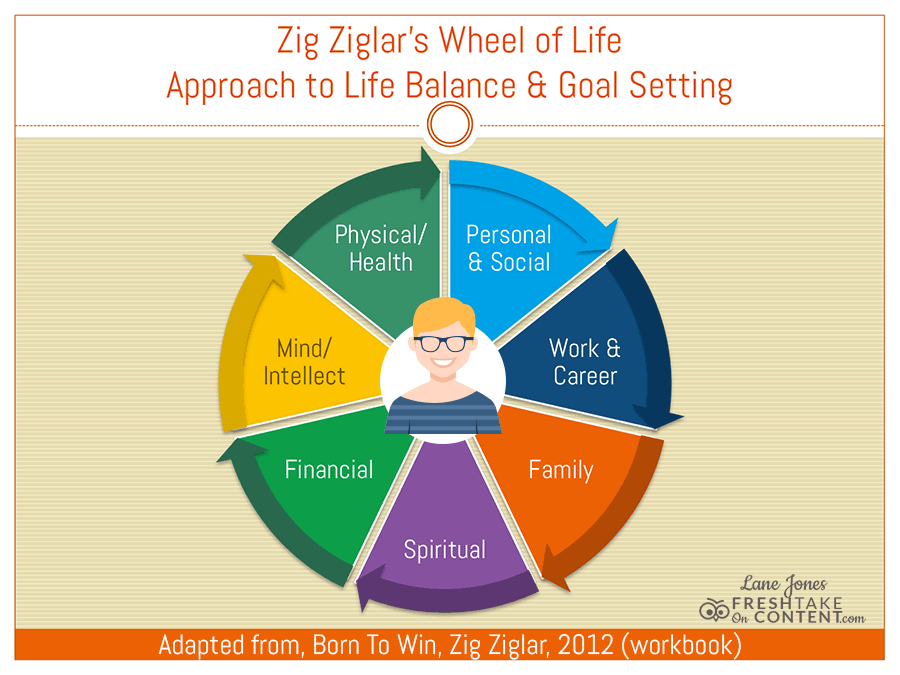
Research shows that your physical health is optimum when you are satisfied in all of the following areas:
Identifying our “weak” area can lead to the most effective goal setting.










 Kismet