I’m in the middle of the National Board of Certification process and one requirement is to take two 15-minute videos of myself teaching and to analyze them. In order to do this, I must view the videos. Repeatedly.
Ugh.
I do not like to hear myself – alone see myself – on screen.
At last, I did it. And you know what? It wasn’t terrible.
So, today, I encourage you to “just do it.” If it needs to be done, but you dread it, know that it’s OK.
If you need a more aggressive motivational message, watch Shia below:
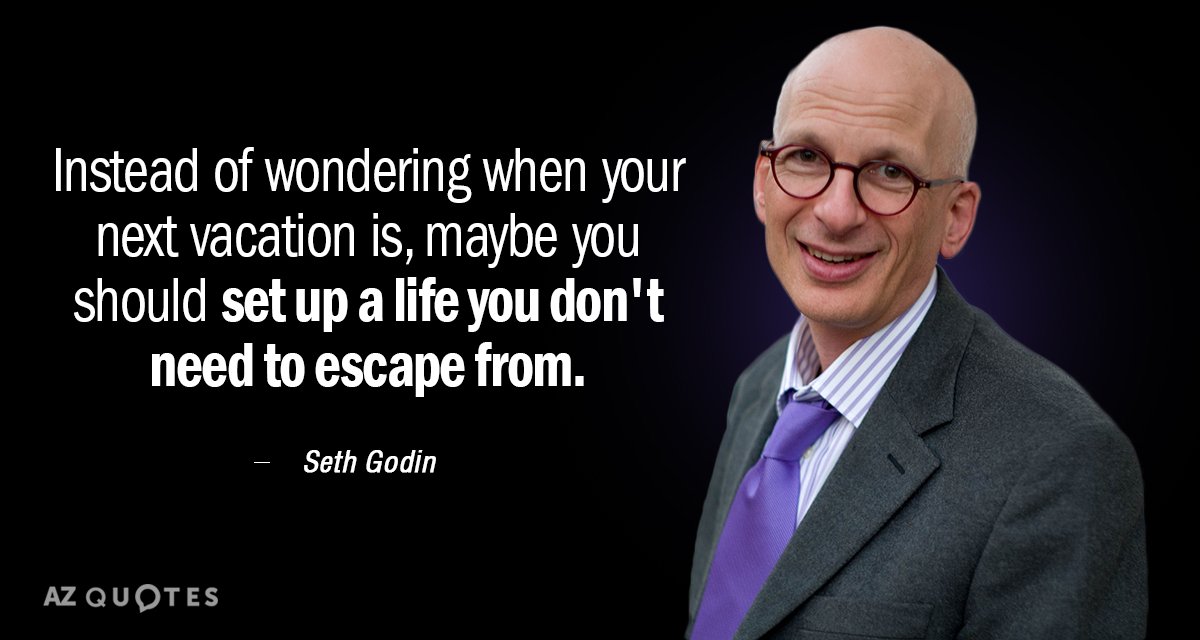
I’m a teacher and I’m usually loathe to listen to any non-teacher who criticizes education. However, Seth Godin is a teacher in his own right and what he has to say makes perfect sense.
Godin published an education manifesto and I think everyone should read it. It’s made a deep impression on me and I’ve made immediate changes to my teaching. Rote memory is ridiculous. Deducting points off for trivial things is dumb. Let’s teach students how to learn and then CREATE things and take ACTION!
I’m in a room of about 100 teachers from all over Arizona. I feel blessed to be here. We’re all pursuing National Board Certification. Sure, we get a (small) financial award, but the biggest reason that we’ve shown up is that each of us will deepen our teaching practice and bring more to each of our 30 – 180 students each day.
The great majority of teachers are exceptional people.
And then there are these bigots (who ought to lose their jobs):
13% of their student body is Latin-American. Idaho needs to do better for the children.
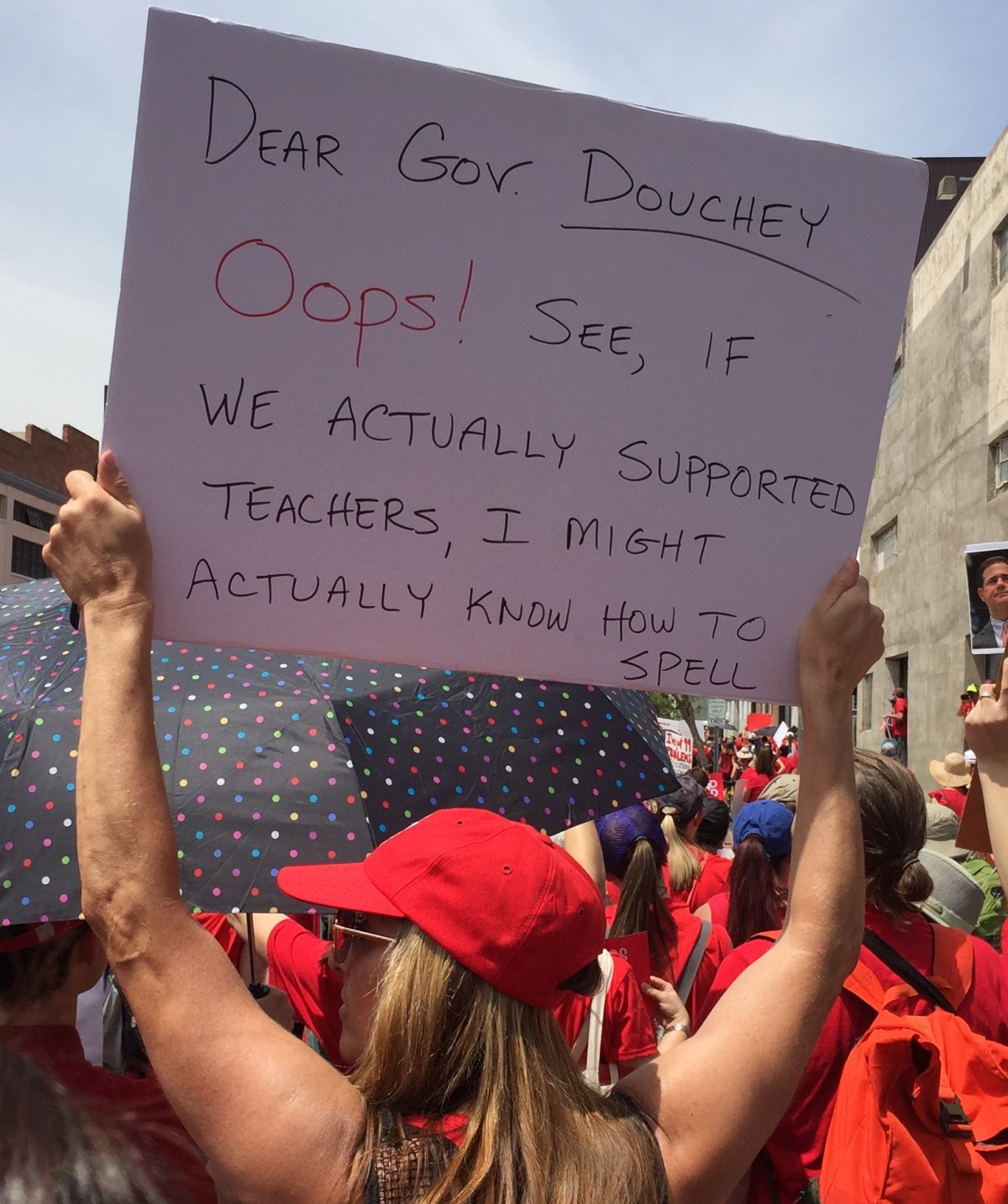
The Red4Ed Walkout was a stunning success: 75,000 teachers, students, parents and other supporters marched from Chase Field to the Capitol.
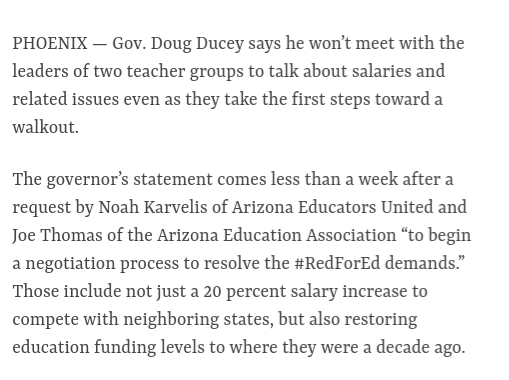
But, of course, there are detractors and fear-mongerers. People who criticize and tell us we’re letting the children down. Who’s letting the children down? Governor Ducey won’t even meet with our AEU! The Legislators took TODAY (a FRIDAY) OFF!
Chandler teachers were told to show up for work on Monday (4/30) or else (!)
But when realizing that too many teachers were standing up for their students and education in Arizona, they backtracked:
Ryan Holiday recommends seizing the “alive time.” You know, the moment in front of you – the only one that counts. Look into the eyes of the person speaking to you, don’t check your phone when at lunch with others.
Alive time.
“Face fears. Reach out and connect with someone. Do something you’ve been putting off. Expose ourselves to sunlight and nature. Be still and empty. Prepare for what lies ahead. Or just live because who knows how much time we have left.”
Ryan Holiday
Today, educators from all over Arizona are marching from Chase Field to the Capitol. We are working to create change. Change is uncomfortable. It’s not easy. But it’s necessary and unavoidable.
I march for Lily, who wants to be a teacher someday.
I march for my students, who deserve resources to learn and become critical thinkers and productive adults in our society.
I march for myself and my peers who deserve to have resources to get our jobs done and to feed our families.
I march for education which is the only antidote to discrimination, violence and inhumanity.
*9th Habit from From Ryan Holiday’s blog “13 Habits You Should Adopt Every Single Day” (Thought Catalog)
The author of this book, Paul Tough, did NOT graduate from college!
Tough does not fit the demographic of college dropouts: He came from a well-to-do family; and got admitted to (and briefly attended) Columbia University.
However, he was rebellious after high school (where he did very well). Inspired by Jack Kerouac, he wanted to travel and do something uncertain, unsafe…something he felt uncertain if he could succeed at. Believe he would learn more on the road than on the campus.
Steve Jobs’ famous graduation speech at Stanford (2005): Job told graduates that dropping out “had been one of the best decisions I ever made.”
allowed him to take classes he was interested in (calligraphy, typography)
this led to his creative typography in personal computers – distinguished Mac from all other computers
Biggest failure – being fired from Apple – a very public failure
allowed him to reorient himself and his work that led to his greatest successes: buying and transforming Pixar, getting married, returning to Apple rejuvenated
“The heaviness of being successful was replaced by the lightness of being a beginner again, less sure about everything.”
Paul Tough: became a magazine editor and journalist. Twenty-four years after dropping out of Columbia, Tough quit the New York Times and wrote this book.
2. LG Parenting
Remember the high and low level Licking and Grooming experiment with rats?
Paul Tough thinks about that often now that he has become a new father.
Realizes that the most reliable way to produce and adult who is brave and curious and kind and prudent is to ensure that when he is an infant, his hypo-pituitary-adrenal his functions well. How?
Protect him from serious trauma and chronic stress;
provide him with secure, nurturing relationship with at least one parent, ideally, two.
provide lots of comforting, hugging, talking and reassuring;
also provide discipline, rules, limits, someone to say “no”;
help him to learn how to manage failure;
“More and more graduates from prestigious colleges are going into investment banking and management consulting and far fewer become artists, entrepreneurs and iconoclasts. Why? Because Wall Street decision is easier…they are driven by fear of not being a success than by a concrete desire to do anything in particular.” p. 184
3. A Different Challenge
Liberals and conservatives differ greatly on how the government should aid families in poverty, but just about everyone agrees we need to do something.
“The government should guarantee every citizen enough to eat and a place to sleep.”
In 2012, the child poverty rate was 22%. This means between a fifth and a quarter of American children are growing up in poverty. (From 1966 to 2010, the child poverty rate was 15%.)
Unsurprisingly, children who grow up in poor families in the United States do very poorly in school.
If we can help poor children escape the cycle of poverty, we can help them improve their academic skills and academic outcomes.
Conclusion: We could replicate on a big, national scale the accomplishments of the schools outlined in this book and make a huge dent on poverty’s impact on children’s success.
4. A Different Kind of Reform p. 189
For a long time, educational reform was focused on teacher quality and they way teachers are hired, trained, compensated and fired.
Whatever your stance, research on teachers remains inconclusive in some important ways:
we don’t know how to reliably predict who will be a top-tier teacher in any given year;
variations in teacher quality accounted for less than 10% of the gap between high and low-performing students.
The only official indicator of the economic status of an American public-school student today is his or her eligibility for a school-lunch subsidy.
If you qualify for subsidies, you probably can’t afford adequate shelter, nutritious food, new clothes, books or educational toys. Statistically, you are likely being raised by a poorly educated, never-married single mother.
5. The Politics of Disadvantage
The biggest obstacles to academic success that poor children, especially very poor children, often face: a home and a community that create very high levels of stress, and the absence of a secure relationship with a caregiver that would allow a child to manage that stress.
Character matters: grit, resilience, perseverance and optimism.
Perry Preschool – 128 children in poverty randomly chosen to attend high-quality preschool program. Experts believe that the school gave a return between $7 to $12 for each dollar spent.
The website displays data that starting quality education for the very poor at an early age has lasting effects (through the participants’ 40s)!











 Kismet