Since taking a (trial) Lisa Congdon art class in watercolor, I’ve made drawing and painting part of my morning ritual. I don’t know where this will lead me (maybe my second self-published children’s book as author and illustrator?)…but I know I enjoy the process.
Subscription options for Creativebug.com are below:
They offer a multitude of art classes:
When you consider the cost of classes at your neighborhood art academy or fabric store, this is a steal: unlimited classes all month for $8!
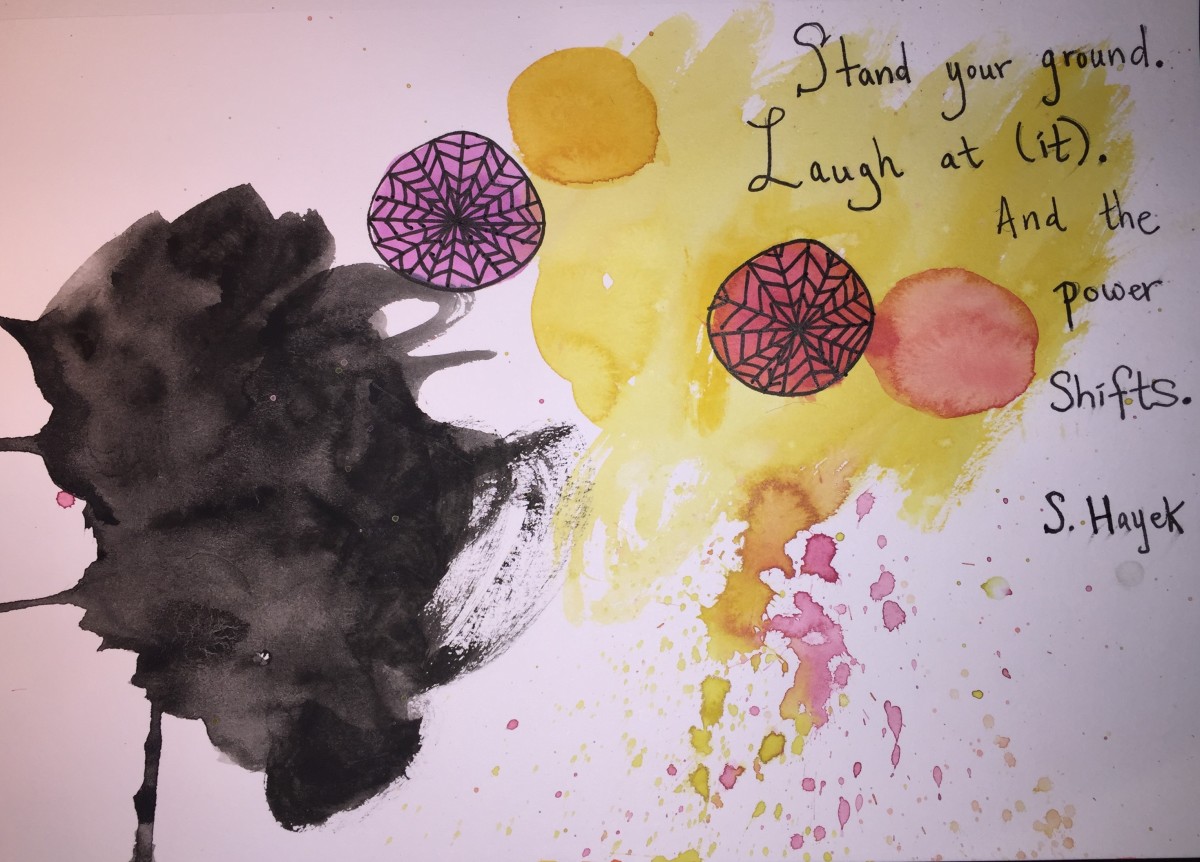
Salma Hayek told Oprah a story: When she was 10, there was a neighborhood flasher. This man accosted her and exposed his full frontal nudity. “I was terrified, just so scared…” She went home and told her grandmother who then gave this advice (Hayek offered a disclaimer – she is by no means telling little girls they ought to do this) BUT…
“The next time that man flashes you – even if you are terrified and alone – LAUGH at him. Point at his groin and LAUGH.”
The man DID flash her again. And little Salma stopped. She felt her entire body tighten with fear. But she remembered her grandmother’s advice. So she stared, pointed at his groin and laughed.
“He ran away, he cowered and ran away!” Hayek says, still incredulous.
This post is designed mainly to hold myself accountable for research. I hope you can glean something from it at the same time. The following are my notes from Paul Tough’s book, “How Children Succeed”:
Simon p. 19
Data has shown (for a long time) that executive function correlates with family income
But why?
Childhood poverty affects executive function (Cornell Univ., Gary Evans, Michelle Schamberg)
Working memory – ability to keep a bunch of facts in your head at the same time
“Simon” – children’s game
Kids in poverty for 10 years did worse than kids in poverty for 5
Evans and Schamberg also measured biological stress (They created their own allostatic load data) – BP, cortisol levels, body mass index, etc). Of kids when they were nine and then thirteen
When they factored out the allostatic load, poverty factor disappeared. Thus, it is not POVERTY that compromises exec-function abilities, it’s the STRESS that went with it!
Why is this important? Because in high school, college, and the workplace, life is filled with tasks where working memory is crucial to success.
Prefrontal cortex is more responsive to intervention than other parts – stays flexible into early adulthood.
Mush
Early childhood – bodies and brains are most sensitive to effects of stress and trauma
Adolescence – can lead to most serious and long-lasting problems
The reason teenage years are most perilous: incentive processing system reaches full power while the cognitive control system isn’t matured until early 20s.
Thomas Gaston (“Mush”) kicked out and sent to Vivian E. Summers Alternative HS
He didn’t like it, but he did well
Until he carjacked someone
Potential sentence of 21 years was changed to 8 months of boot camp
Mush took his allostatic load and turned outward with violence (fighting, acting up in class). Some kids turn it inward (fear, anxiety, sadness, self-doubt).
Mush decided to “not care” after his 14 year old brother was shot and killed.
Social, economic and neurochemical factors are at play. A 10 year old vs. a 14 year old: we sympathize with the 10 year old.
LG
There is an antidote to the ill effects of childhood stress!
Good parenting.
It is biochemical.
Michael Meaney (McGill University)
Rats and mothering – some were nurturing, others not.
“LG” – Licking and Grooming (High vs. Low)
It is not necessarily the biological mother, but the REARING mother’s behavior that counts.
Attachment
“Methylation” – the way certain chemicals are affixed to certain sequences on DNA
Showed that subtle parenting behaviors had predictable and long-lasting DNA-related effects
Researchers studied brains of suicide victims – some had childhood abuse, some did not
Showed that childhood abuse affected DNA
Clancy Blair (NYU) is reinforcing the finding that high-quality mothering can act as a powerful buffer to abuse
Regular good parenting – being helpful and attentive – can make a profound difference for a child’s future prospects.
“Attachment Theory” (Bowlby and Ainsworth) 1960s and 70s – The Strange Situation: mothers would bring a child into a room, and then leave and then return. The children who greeted their mothers warmly and enthusiastically were “securely attached”. Those children who reacted with tears or anger were “anxiously attached.”
Ainsworth: Reactions were directly related to degree of responsiveness in first year of life.
“Early attachment created psychological effects that could last a lifetime.”
11.Minnesota
Waters and Sroufe – set up a Child Development Institute with Egeland
The Development of the Person – book is fullest evaluation of long-lasting effects of parental involvement on child’s development (2005)
Found: attachment theory was not absolute – sometimes anxious babies could overcome, BUT it is highly predictive of outcomes later in life
Anxiously attached children are more often labeled mean, antisocial and immature
Parenting Interventions
Lieberman (Child Trauma Research Program at UCSF)
Believes two important ideas missing from Sroufe and Egeland study:
Plainly difficult for some mothers to provide secure attachments in overwhelming life circumstances (poverty, violence, mother’s own childhood history)
Parents can overcome their own histories of trauma and can change their approach but most will need help.
Lieberman’s work focuses on strengthening bond between parent and child
Dante Cicchetti used Lieberman’s work and took 137 families with histories of child maltreatment. Half were given a year of parent-child psychotherapy the other half given the standard community services. When children were 2, 61% of the children in psychotherapy formed secure attachment.
His study proves that attachment-promoting therapies work.
Dozier, of ABC, shows that even if just the parent receives the therapy, children benefit
Visiting Makayla
Makayla – a study in focusing on mother/child attachment.
Steve Gates
“There is a very direct correlation between family issues and what the kids present in school.” The focus on creating family attachments where there are none (in Roseland, for example), have many setbacks, but inspirations form and lead to success.
Keitha Jones
Father was a “player” and mother addicted to cocaine.
Sexually molested in sixth grade – didn’t tell mom, afraid mom would blame her
Got angrier and angrier and took it out at school – caused fights
Got a mentor in Lanita Reed, a hair salon owner
Developed a “big sister” bond with Keitha – teaching her about manicures, pedicures, hair…
“My whole outlook on life changed” Keitha said
Instead of fighting, asked Reed what to do about girls picking on her at school
They arranged a talk and it worked – everything was resolved.
Sexual molester started touching Keitha’s sister and Keitha felt guilt – did not want her sister to be removed from home.
Reed arranged to have the man removed from the home.
Mother was not supportive (lost $300 in rent)
Keitha: “I’m not going to let my past affect my future.”
Determined to graduate, she took night classes five days a week
June 2011, she graduated and attended Truman College, a community college
“Five years from now, I picture myself in my own apartment with my own money…and my little sisters, they can live with me.”
Recently, I (wo)manned a booth at our school’s International Festival. We were making maracas using empty toilet paper rolls, duct tape and (uncooked) beans and rice. Kids of all ages and sizes came to make their maracas.
After just one hour, I realized something: six and seven-year-old girls came up confidently and chose their colors without hesitation. “I want blue! And red! And green!” They taped their rolls, scooped up rice, taped again and smiled radiantly.
Teenage girls, however, hemmed and hawed, wracked with indecision. “Ummmmm. I dunno. I dunno what to choose! Ummmm…” It took them far longer to decide and even after they decided, they second-guessed their decisions and did not seem entirely happy with their results.
Day 21 of 31 Day Painting Challenge (Lisa Congdon – Creativebug.com)
Too often, we confuse “anger” with power. Anger is fear-based. It is never necessary.
Intelligent, creative action can only arise from calmness.
Whenever I give a knee-jerk reaction, I almost always regret it. Yet I’ve never regretted deleting theimpassioned email or biting my tongue until I can address the issue calmly.
Try this: Next time you are offended (which is just your perception of offensive behavior, by the way), do not react. Think about the action or words. Decide if they are true or not. And react calmly (e.g., “Interesting. No, I do not agree.” Or, “I think you might be right!“)
31 Day Painting Challenge: Day 21 Colorful Geometric Shapes
Current symptoms: listlessness, insomnia, constant hood of worry, anxiety, pessimism, road rage
Prescription: (To do at least once a day until symptoms disappear)
Go to a mall or your sister’s house or other place where toddlers are eating or playing (a children’s playground at the park or school is not advised for you might be reported for peculiar behavior – not your fault)
Observe toddler’s feet dangling from the chair; his cherubic cheeks and glistening eyes focused on what’s in front of him;
Note the fat hands hungrily – joyfully – grabbing the sandwich/spoon/bowl;
Listen, really listen, to his easy laughter and his babble.
If you could ask him, he’d tell you:
He’s not worried about tomorrow or fretting about the past;
He’s here, with you, and nothing else matters.
When toddler begins to cry or have a temper tantrum, cease the observation and seek a quiet place immediately.










 Kismet