“Without suffering, there’s no happiness. So we shouldn’t discriminate against the mud. We have to learn how to embrace and cradle our own suffering and the suffering of the world, with a lot of tenderness.”
THICH NHAT HANH
Thich Nhat Hanh goes on to say that we are so afraid of facing our suffering (worrying, anger, despair, fears, loneliness) that we go look for something to eat, or drink or watch TV. And many people do all of those at the same time. Even if there is nothing interesting or satisfying to watch, we are afraid to turn the television off, because then we will be left to face our suffering.
An important skill taught in Driver’s Education courses is to keep one’s eyes where one wants to go (the safe place) and not on obstacles that one wants to avoid. For example, if your car starts to skid out of control, don’t focus on the tree you’re afraid of crashing into, but on the open road. If you focus on the tree, that’s where you’ll end up.
In life, that tree can be a metaphor for the last decades of our lives. We tend to focus on fears such as, “What if I don’t have enough money to retire?”
We live in a youth-centered society. We don’t take care of our elderly very well. So it’s no wonder so many of us fear growing old (despite the fact that it’s inevitable if we don’t die first).
When we choose to stop focusing on aging (and limitations), and start focusing on The Possibilities, fascinating things can happen:
Annie Proulx, this year’s winner of the National Book Award, and author of Brokeback Mountain and The Shipping News, did not start seriously writing until she was 58. (Bigthink)
In the middle of his prolific career as inventor and businessman, Thomas Edison’s plant was burned down by a fire – all of his work was gone. What was his reaction?
“Although I am over 67 years old, I’ll start all over again tomorrow.”
And he did, the very next day. He didn’t even let any of his employees go. Edison and his team made $10 million the very next year. (BusinessInsider)
My favorite children’s book series is Frog and Toad. I’ve always loved the simplicity and hilarity of the stories and it dawned on me only recently that perhaps Frog and Toad were more than friends. Lobel, author and illustrator, came out to his family pretty late in life and then died from AIDS. Everyone needs to accept everyone for who they are. Why judge others?
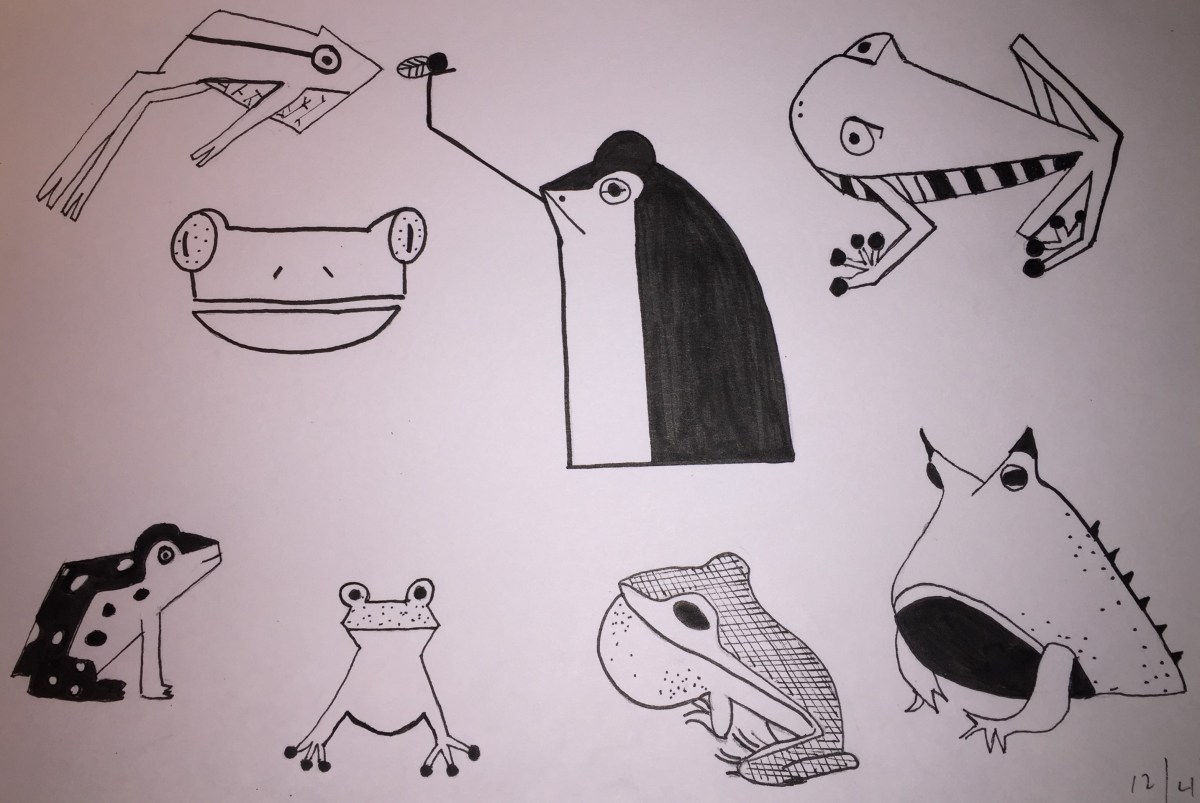
Which brings me to a comment my husband made to me this morning. He was looking over my shoulder, watching me draw the frogs.
“So when are you going to draw your own things?”
“Like what?”
“I don’t know…the things you like.”
“I like what I’m doing. I have drawn things on my own and they were pretty terrible. I’m still learning.”
“Just draw your own things.”
I understand what he’s saying. And I have wondered if I’m playing it safe by drawing out of a book, but I really am a beginner. My goal is to practice drawing until December 31st and then try my own “things.”
I shared my drawing of llamas today with my fifth graders.
I got a rousing, “Not bad!”
For some reason, they loved yesterday’s 5 minute timed writing prompt:
“Describe how to drive your teacher crazy.”
Ahhhh. Kids.
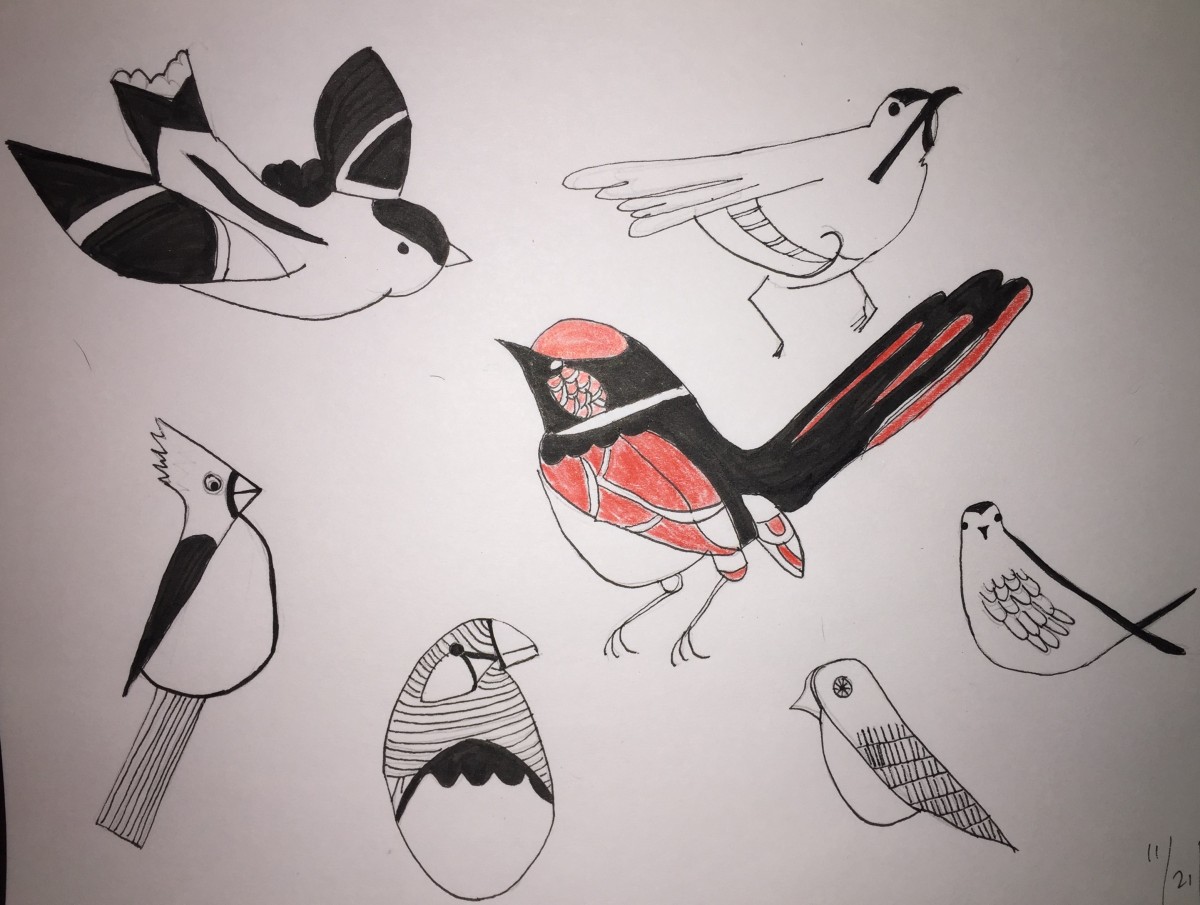
Each morning, I open my drawing book, 20 Ways to Draw Everything. I make myself draw whatever is in front of me. I am always tempted to draw the easiest figures. I might start with the easiest, but I know that I will not get better if I stick to the simple ones. My initial goal was to draw all 20, but because I have only 45 minutes to draw before I go to work, I choose about six: a few easy, a few difficult.
I’ve been listening to podcasts. Many podcasts. My favorites are Tony Robbins and Optimal Living Daily. Recently, I heard Esther Perel on Tony Robbins and it was mind-blowing! I learned so much. I’m in a healthy marriage, but I know a lot of people are not. I thought I’d share some interesting tidbits here. Perel, by the way, is a relationship expert. She’s been studying relationships for 35 years. Esther is the daughter of Holocaust survivors. She’s amazing and you can read more about her here.
The following information is from Tony’s podcast with Esther, Part II:
It’s our differences that create passion.
Triggers for affairs – Two main reasons:
feeling neglected, loneliness, sexual frustration, a deadness inside (bad marriages)
to feel “alive” – the absence of obligation and burden (good marriages). Not for sex, but for desire and aliveness.
People having affairs are not looking for another partner, but a new “self”
How to recover from an affair:
acknowledge the pain you created with the affair (remorse);
prove how much you want to stay – give back the value of your partner;
help your partner understand why you did it (a list of hotels is NOT the answer);







 Kismet